National Food Security and Research
Senate of Pakistan
News Detail
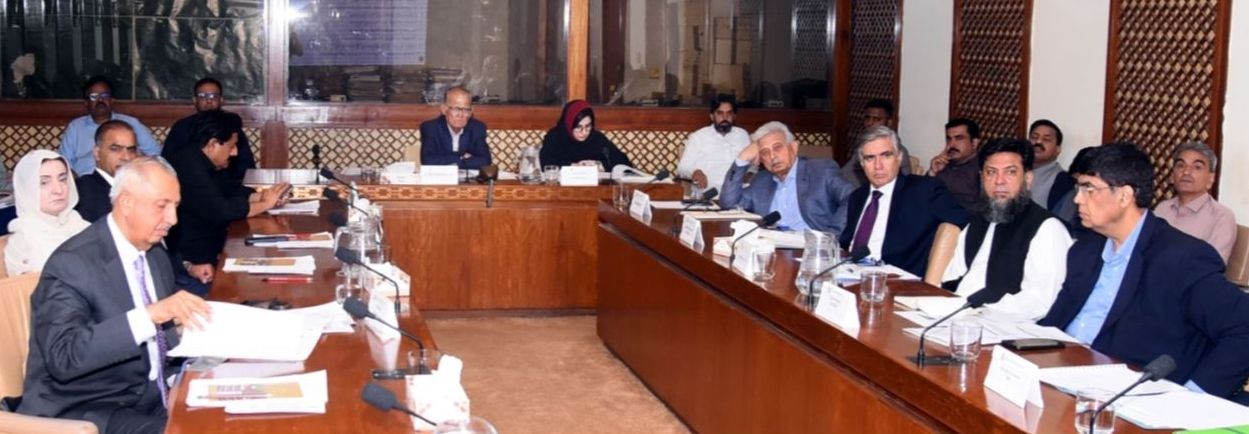
Press Release Title: Senator Syed Masroor Ahsan, Chairman Senate Standing Committee on National Food Security and Research presiding over a meeting of the Committee at Parliament House Islamabad.
Press Release Date: 21st May, 2026
The Senate Standing Committee on National Food Security and Research on Thursday held a detailed meeting under the chairmanship of Senator Syed Masroor Ahsan to review the state of Pakistan’s agricultural sector, wheat production, seed policy, cotton crisis, agricultural research reforms and coordination challenges between the federation and provinces. Federal Minister for National Food Security and Research Rana Tanveer Hussain informed the committee that turning around the agricultural sector remains the Prime Minister’s top priority, stating that agriculture is the backbone of Pakistan’s economy and sustainable reforms are being introduced to revive productivity, modernize research institutions and strengthen farmer support mechanisms. The committee was briefed on the low per-acre production of wheat and rice, as well as government initiatives undertaken during the last two years to increase wheat production across the country. Addressing the committee, Rana Tanveer Hussain acknowledged that Pakistan’s agricultural productivity remains significantly lower than regional competitors, particularly India and China. He informed members that Pakistan currently spends only 0.02 percent of GDP on agricultural research, whereas India allocates 0.4 percent of GDP to the sector. He added that China is being treated as a model for agricultural development and that Chinese agricultural experts had conducted a comprehensive review of Pakistan’s agricultural system. The Federal Minister stated that the Prime Minister had approved wide-ranging recommendations for agricultural reforms and research enhancement. He said reforms were being implemented in agricultural research institutions, including the Pakistan Agricultural Research Council (PARC), while efforts were underway to improve coordination between federal and provincial institutions. “If money is not invested in agricultural research, desired results cannot be achieved,” the minister stated. Rana Tanveer Hussain further informed the committee that PARC was being transformed into a modern center of excellence with special emphasis on research, technology and modern seed development. He added that banks had been directed to increase lending facilities for the agricultural sector and that financial institutions were being mobilized to support agricultural mechanization and farmers’ welfare. During the meeting, Senator Shahadat Awan raised questions regarding farmers’ actual income and the ministry’s overall performance. He observed that farmers in villages primarily evaluate agricultural success through profit earned per acre and stressed the need for a realistic comparison between production costs and farmer income. “There is a clear difference between Pakistan’s agricultural production and its actual potential,” Senator Shahadat Awan remarked, adding that if the productive capacity of agricultural land was significantly higher, the causes behind declining output must be transparently identified. The Federal Minister informed the committee that floods, heatwaves and changing weather patterns had adversely affected wheat production this year. He said the wheat production target had initially been fixed at 30 million tons but estimates had subsequently been revised downward owing to climatic impacts. He further disclosed that farmers’ organizations had demanded a wheat support price of Rs3,200 per maund, while the government fixed the price at Rs3,500. According to the minister, the production cost of wheat currently stands at approximately Rs2,600 per maund. Rana Tanveer Hussain informed the committee that provinces had failed to evolve consensus on wheat procurement targets, adding that the Sindh government had announced procurement of only 100,000 tons of wheat. “The provinces are not cooperating in the agricultural sector and problems have increased after devolution,” he stated. Senator Shahadat Awan again questioned the ministry regarding the actual productive capacity of Pakistan’s agricultural land. “If the land can produce 40 tons, why are only 10 tons being produced?” he asked, emphasizing that farmers must be provided quality seeds, water and fertilizers. He also highlighted complaints regarding fertilizer pricing and urged the committee to formally write to provinces for improved cooperation. Chairman Committee Senator Syed Masroor Ahsan declared agricultural extension services as the most critical component of agricultural development and expressed concern over delays in key agricultural infrastructure projects. “Despite allocation of billions of rupees for agricultural laboratories in Khuzdar and Turbat, the work could not be completed,” the chairman observed. He further emphasized that effective cooperation between the federation and provinces was indispensable for overcoming agricultural challenges and ensuring food security. The committee was also informed about consultations with provinces regarding the national seed policy. Rana Tanveer Hussain admitted that broader consultation was still required and announced that the matter would be deferred for further discussion. “After passage of the budget, a policy will be brought through consensus,” he stated. Senator Abid Sher Ali voiced serious reservations regarding the deteriorating condition of farmers and the cotton sector, warning that rising input costs and flawed import policies had devastated cotton growers. “Pakistan has turned from a cotton exporting country into a cotton importer,” Senator Abid Sher Ali stated. He informed the committee that the traditional cotton belt stretching from Faisalabad to Sadiqabad was rapidly shrinking, while several factories had shut down and the cotton sector was nearing collapse. He further alleged that sugarcane cultivation was replacing cotton due to the influence of sugar mills and claimed that farmers were being exploited for the benefit of a few influential mafias. “Imported cotton is enjoying zero tax while taxes are imposed on local cotton,” he remarked, demanding the establishment of an effective agricultural coordination mechanism between the federation and provinces. Responding to concerns regarding fertilizer shortages, Rana Tanveer Hussain stated that there was no fertilizer shortage in the country and that price differences were not substantial. He informed the committee that sales centers of FFC, Engro and Fatima Fertilizer had been established across the country and maintained that fertilizer prices in Pakistan remained comparatively lower than global rates. The minister also informed the committee that Pakistan’s first comprehensive seed policy had been introduced and asserted that GMO and hybrid seed technologies possessed the potential to double agricultural production. He acknowledged that weak implementation of zoning plans by provinces and expansion of sugarcane cultivation had adversely affected cotton-producing areas. “The major reason behind low cotton production is that farmers do not receive fair prices,” Rana Tanveer Hussain stated. During the meeting, Senator Shahadat Awan sought details regarding amendments made to seed rules in 2016 and 2021 and raised questions over overlapping provisions and the legal status of new seed business regulations. He demanded clarification regarding licensing procedures, regulatory mechanisms and the proposed amendments to the Seed Act intended to be introduced in Parliament. The committee also received a briefing regarding proposals for the establishment of sugar mills in cotton-producing regions following requests made by the Pakistan Cotton Ginners Association. The meeting was attended by Senators Shahadat Awan, Abid Sher Ali, Poonjo Bheel and Rahet Jamali , alongside Federal Minister for National Food Security and Research Rana Tanveer Hussain and senior officials of the ministry.