National Food Security and Research
Senate of Pakistan
News Detail
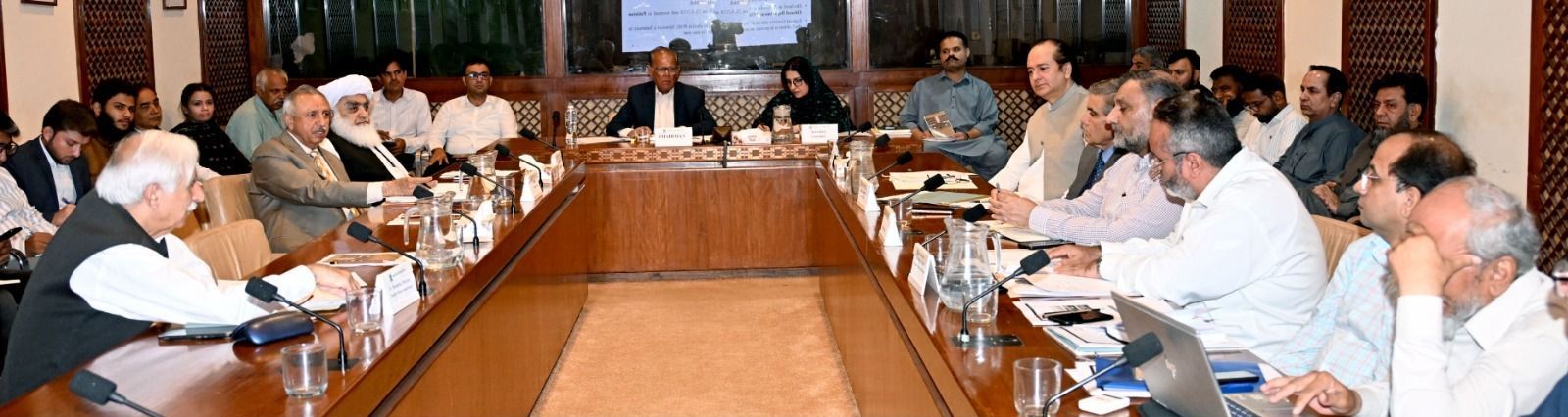
Press Release Title: Senator Syed Masroor Ahsan, Chairman Senate Standing Committee on National Food Security and Research presiding over a meeting of the Committee at Parliament House Islamabad
Press Release Date: 1st July, 2026
The Senate Standing Committee on National Food Security and Research met under the chairmanship of Senator Syed Masroor Ahsan to review the performance, future status and national importance of the Pakistan Oilseed Department (POD), with members expressing concern over Pakistan’s growing dependence on imported edible oil and stressing the need to strengthen domestic oilseed production. Meeting was attended by Senator Abdul Wasay, Senator Shahadut Awan, Secretary Ministry for National Food Security and Research and other senior officials of relevant department. Opening the meeting, Chairman Committee Senator Syed Masroor Ahsan underscored the strategic importance of the oilseed sector, stating that oilseed is an important crop and Pakistan must take concrete measures to reduce its import dependence. He noted that the country's annual per capita consumption of ghee and edible oil stands at 17 kilograms, making the promotion of local oilseed production a matter of national economic importance and food security. Managing Director Pakistan Oilseed Department Basharat Hussain Shah briefed the committee on the department's performance and the state of the oilseed sector. He informed the committee that sunflower cultivation in Pakistan covered 1.1 million acres in 2011 but declined sharply to only 171,000 acres following the devolution of agriculture to the provinces. He further informed members that the department launched a National Oilseed Enhancement Programme in 2019 to increase domestic oilseed production. Secretary Ministry of National Food Security and Research Aamir Ali Ahmed informed the committee that the federal government had decided to abolish the Pakistan Oilseed Department with effect from January 1, 2025, on the grounds that agriculture is a provincial subject following the 18th Constitutional Amendment. However, he said that in view of the strategic importance of oilseed production, the ministry had submitted a summary to the federal cabinet recommending the continuation of the institution. The Secretary explained that although the department's role had been limited after the 2011 devolution, it had not been eliminated. He said the ministry is currently implementing a national programme to increase oilseed production, while the department's major focus remains the promotion of olive cultivation. He added that funds have been allocated for both programmes, which have produced encouraging results in Potohar, Balochistan and Khyber Pakhtunkhwa. He further informed the committee that the Pakistan Oilseed Development Board had been abolished and replaced by the Pakistan Oilseed Department as a subsidiary institution. However, he acknowledged that the department continues to face uncertainty regarding its future. He also stated that the institution is presently receiving government funding and that the ministry has proposed limiting the department's mandate to federal responsibilities. Senator Shahadat Awan questioned the rationale behind continuing the department after the government's decision to abolish it nearly one and a half years ago. He made references stating that subordinate departments lacked financial resources and were unable to function effectively. He further stated that the Federal Minister had informed the committee that the Secretary had written eight letters to the provinces but received no response, adding that the provinces were placing a heavy burden on the federation by allegedly failing to cooperate. It was decided that the provinces should also be called in the next meeting and take briefing on relevant issue. Responding to these concerns, Secretary Aamir Ahmed Ali said the federal government is fully performing its responsibilities and has continued national-level programmes despite constitutional limitations. He reiterated that the institution had made significant contributions to promoting olive and sesame cultivation across the country. Senator Shahadat Awan stressed that all actions must remain within the framework of the Constitution and asked whether the provinces had been taken into confidence regarding the proposed restructuring of the department. He also remarked that there were several controversial aspects in the ministry's presentation and questioned federal expenditures at a time when the government was seeking additional financial resources through the National Finance Commission. Chairman Committee Senator Syed Masroor Ahsan observed that every issue was being attributed to the 18th Constitutional Amendment and called for a practical approach to resolving challenges facing the sector. Referring to international cooperation, he said Italy had extended assistance for the promotion of olive cultivation, while Malaysia had supported palm oil promotion, but those initiatives had eventually disappeared. Officials informed the committee that Pakistan's annual edible oil import bill has now exceeded 5 billion US dollars and is expected to rise further if domestic production is not enhanced. They stated that the federal government allocated Rs 4 billion between 2020 and 2026 to increase oilseed production, while local oilseed production generated economic benefits worth Rs 364 billion during the same seven-year period. The committee was informed that import duties on oilseeds have remained fixed at only 3 percent in Pakistan for the past ten years, compared to 36 percent in India. Officials further informed members that Pakistan imposes a duty of Rs 10,000 per tonne on palm oil imports, whereas India charges Rs 106,000 per tonne. Similarly, Pakistan's duty on canola imports stands at Rs 6,864 per tonne, compared to Rs 49,442 per tonne in India. Officials also informed the committee that attempts to cultivate palm oil in Pakistan have not achieved the desired success. Concluding the discussion, Chairman Committee Senator Syed Masroor Ahsan directed the Ministry of National Food Security and Research to provide the committee with complete details of edible oil imports over the last three years to facilitate a comprehensive review of the country's import dependence and future policy direction. He reiterated that reducing edible oil imports through increased domestic oilseed production must remain a national priority to strengthen food security and reduce the burden on the national economy.