Interior and Narcotics Control
Senate of Pakistan
News Detail
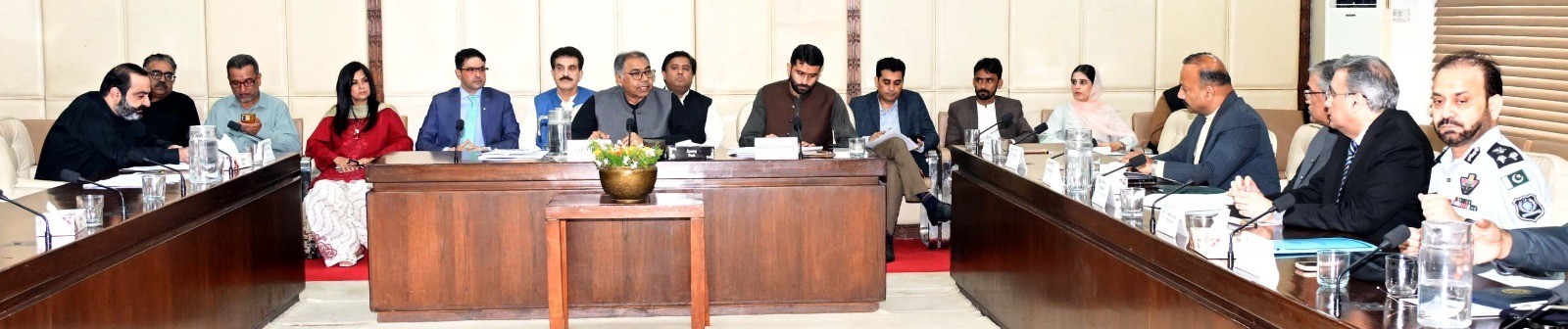
Press Release Title: Senator Saifullah Abro, Convener Sub-Committee of the Senate Standing Committee on Interior and Narcotics Control presiding over a meeting at Parliament House Islamabad
Press Release Date: 2nd November, 2026
Senate Sub-Committee Expresses Serious Concern Over Alleged Tax Evasion Under FATA/PATA Tax Exemption Scheme and Delayed Recovery of Billions in Tax Dues; Directs Review of FBR Performance and Nominations for Sitara-i-Imtiaz Pakistan is seeking loans from the IMF, while the recovery of approximately Rs800 billion in alleged tax dues from the national exchequer remains in question. “We will recover the nation’s money at all costs. Whether I remain in the Senate or not, I will bring the country’s money back,” says Convener Senator Saifullah Abro. FBR Not Serious About Tax Collection Prime Minister Being Misbriefed, Says Senator Saifullah Abro; FBR Fails to Produce Required Documents Before Committee in Billions of Rupees Tax Dues Case Those Responsible for Potential Losses to the National Exchequer Must Be Held Accountable; Negligence in Tax Recovery Will Not Be Tolerated, Says Convener; Directs Review of FBR Performance and Sitara-i-Imtiaz Nominations Why Is Tax Recovery Delayed When Pakistan Is Compelled to Borrow? Responsibilities for Tax Evasion Must Be Determined and Recovery of Public Money Ensured; Officials Will Be Held Accountable for Failure to Protect the National Exchequer, Says Senator Saifullah Abro A meeting of the Senate Sub-Committee on Interior and Anti-Narcotics was held at Parliament House, Islamabad, under the convenership of Senator Saifullah Abro. The meeting reviewed in detail the alleged misuse of the FATA/PATA tax exemption scheme, the issuance of consumption certificates relating to the use of imported goods, non-payment of tax dues, failure of the relevant companies to provide the required records, and progress in ongoing investigations. During the meeting, the Convener expressed serious displeasure over the performance of the Federal Board of Revenue (FBR), raising grave concerns about potential losses to the national exchequer, delays in the recovery of tax dues, and the non-provision of relevant documents. Convener Senator Saifullah Abro stated that, on the one hand, Pakistan was compelled to seek loans from international financial institutions to meet its financial requirements, while, on the other, delays in recovering billions of rupees in alleged tax dues and the performance of the relevant institutions were raising serious questions. He questioned why effective measures were not being taken to recover the money if the amounts were legally payable to the national exchequer. He categorically stated that negligence and unnecessary delays in tax collection were unacceptable under any circumstances. He emphatically declared that the recovery of public money would be ensured at all costs. “Whether I remain in the Senate or not, I will bring the country’s money back,” he said. He maintained that national resources were held in trust for the people and that there was no room for compromise, pressure or negligence in protecting them. He added that if investigations established tax evasion, financial irregularities or violations of the law, those responsible must be identified, legal action taken in accordance with the law, and the outstanding amounts deposited back into the national exchequer. Senator Umar Farooq, along with officials from the Ministry of Interior, the Federal Board of Revenue (FBR), the Federal Investigation Agency (FIA), the police and other relevant departments, attended the meeting and briefed the Committee on various aspects of the matter. During the briefing, the Committee was informed that imported goods worth approximately Rs1,120 billion under the FATA/PATA tax exemption scheme were under scrutiny. According to information provided by the relevant authorities, records and details of consumption certificates relating to goods worth approximately Rs389 billion had been identified, while further clarification was required regarding the use of the remaining goods, the relevant documentation and outstanding tax liabilities. The briefing further revealed that a total of 223 consumption certificates had been issued for 108 companies. The Committee questioned why complete details regarding imported goods, their utilisation, factory production and tax payments were not available for all relevant companies when the total value of imports was reported to be approximately Rs1,120 billion. The Convener expressed serious concern that the unavailability of records and delays in investigations involving such a substantial financial amount could jeopardise the interests of the national exchequer. He said the relevant institutions were responsible for satisfying the Committee through concrete documentary evidence rather than merely offering explanations. He made it clear that a lack of seriousness, inadequate oversight and attempts to shift responsibility would not be tolerated in matters concerning public funds. He directed that a separate and comprehensive file be prepared for the case, incorporating the import records of the relevant companies, customs documentation, issued certificates, tax payments, bank statements and all other necessary documents. He emphasised that potential tax liabilities and financial losses must be accurately determined after verification of authentic records, without any unnecessary delay. The Convener also asked the relevant officials to explain the basis and supporting documentation used in relation to approximately Rs85 billion and to clarify the extent to which legal requirements had been fulfilled during the release of goods following the issuance of the relevant certificates. The meeting held a detailed discussion on the procedure for issuing consumption certificates. The Committee was informed that, under the applicable procedure, companies were required to deposit a payment or pay order equivalent to the value of the imported goods with the customs authorities, after which the goods were supplied to the relevant factories upon fulfilment of the prescribed conditions. According to the officials, several conditions and documents were required for the issuance of consumption certificates under SRO 2021. These included electricity and gas bills, the buyer’s bank statement, company business records, employee details and other relevant documentation. The Convener questioned why compliance with the prescribed legal conditions and verification procedures had not been ensured when clear requirements were already in place for the issuance of certificates. He directed that the consumption certificates and relevant documents of the 20 major companies identified during the previous meeting be presented before the Committee to determine whether the certificates had been issued in accordance with the prescribed legal requirements. He stated that the relevant officers and inspectors were responsible for thoroughly examining the documents submitted by companies before issuing certificates. If any document was incomplete or contained discrepancies, it was the responsibility of the concerned authorities to seek clarification from the relevant company and take the necessary action under the law. He emphasised that responsibility must be determined wherever negligence or a lapse was identified at any level. The Convener directed the relevant authorities to provide complete correspondence concerning companies whose certificates had been questioned. In cases where no objection had been raised against a company, the reasons for this, along with records showing how the relevant officers had scrutinised the documents, were also to be submitted. He made it clear that the required records must be provided to the Committee within two days so that the matter could be examined thoroughly and responsibility determined. He observed that the non-provision of documents or the use of delaying tactics in a case involving billions of rupees would increase doubts and suspicions. The relevant institutions, therefore, had to present complete records of their performance and actions. FBR representative Mr. Taqi informed the Committee that a legal procedure existed for verifying taxpayers’ documents and declarations in matters involving consumption certificates. He explained that where fraud or non-payment of taxes was suspected, the relevant taxpayers could be selected for audit, during which their documents would be examined and verified. He stated that further scrutiny was currently required to determine conclusively the revenue loss or recoverable amount in cases involving consumption certificates. The FBR was auditing the relevant cases, and the findings emerging from the audits would be presented before the Committee. The FBR representative thanked the Committee for highlighting the matter and assured it that if the audit established tax liabilities or recoverable amounts against any company, action would be taken in accordance with the law. Senator Saifullah Abro expressed dissatisfaction with the FBR’s explanation, stating that merely saying an audit was underway was insufficient in a matter of such magnitude involving the national exchequer. He said the Committee also needed to know what progress had been made so far, which companies had submitted their records, how many cases had been examined, and what practical measures had been taken to recover potential outstanding dues. He observed that the FBR did not appear serious about tax collection and that the Prime Minister of Pakistan was being misbriefed. He called upon the relevant officials to present complete facts before the Committee and explain the reasons for delays in recovering tax dues. He stressed that it was the responsibility of the relevant institutions to provide the Prime Minister and the Government with accurate and complete information on matters concerning the national exchequer. The Convener clarified that the purpose of the Committee was not to interfere in the legal jurisdiction of any institution but to ensure that the relevant authorities effectively fulfilled their responsibilities to protect the national exchequer. He emphasised that the FBR must discharge its legal obligations, provide the required records and take practical steps to recover outstanding taxes on the basis of investigation findings. The meeting was also briefed on notices issued by the FBR to companies and the status of record submission. According to the officials, notices had been issued to a total of 512 companies. Some companies had provided complete records, while others had submitted only partial documentation. The briefing further revealed that letters sent to 58 companies had been returned or that the companies concerned had refused to receive them. Officials also informed the Committee that 35 writ petitions had been filed before the Peshawar High Court, while 174 beneficiary companies had approached the court seeking judicial relief to halt the FBR inquiry or related proceedings. The Convener expressed serious concern over these developments, stating that the failure of companies to provide the required records and the emergence of legal complications during investigations could hinder an effective examination of the matter. He directed the relevant authorities to compile complete records containing the names of all companies, details of their owners and business activities, service of notices and pending litigation. He stated that the relevant institutions must present their positions before the courts on the basis of solid evidence and documentary records, ensuring that the interests of the national exchequer remained effectively protected during legal proceedings. Where companies were failing to provide records, the authorities were directed to exercise the legal powers available to address the situation and keep the Committee informed of further developments. The meeting also held a detailed discussion on the investigation being conducted by the FIA. The Committee was informed that an inquiry was underway on the basis of relevant records and information, examining facts relating to imported goods, consumption certificates, the activities of the relevant companies and outstanding tax liabilities. The Convener stated that Director General FIA Dr. Usman Anwar, along with other relevant officials, had been invited to examine the matter and help advance the investigation effectively. Emphasising close coordination between the FIA and the FBR, he said both institutions should exchange the available information and documentation. If evidence of violations of the law or financial irregularities emerged against any company or official concerned, a thorough investigation must be conducted and action taken in accordance with the law. The Convener stated that the relevant institutions must avoid unnecessary delays. If tax evasion or fraud was established, the outstanding taxes and penalties must be recovered and, where required under the law, criminal cases registered and other appropriate legal action initiated. He further stated that potential taxes or penalties amounting to approximately Rs400–500 billion, which were under discussion in connection with the possible loss to the national exchequer, must be conclusively determined after verification of authentic records and legal scrutiny. He stressed that every possible legal avenue must be pursued to protect the national exchequer and that recovery efforts must not remain confined to routine office procedures. Senator Saifullah Abro stated that the FBR was an important financial institution of the country and that it would be encouraging if the institution effectively fulfilled its responsibilities by pursuing the recovery of tax dues and taking action to prevent irregularities. However, he emphasised that weaknesses in performance, unnecessary delays or negligence in discharging responsibilities must also be examined. He observed that public offices and political governments were temporary, whereas the responsibility to protect the national exchequer and public resources remained permanent. No public officeholder or institution could be considered exempt from this responsibility. He made it clear that if evidence of tax evasion or fraud existed against the relevant companies, it must be brought to light and no individual or institution should be considered above the law. The Convener also emphasised that failure to provide the required documents could undermine the ability of the relevant institutions to present their cases effectively before the courts. Timely submission of records, fulfilment of legal requirements and demonstrable progress in investigations were therefore fundamental responsibilities of the concerned authorities. Convener Directs Review of FBR Performance and Nominations for Sitara-i-Imtiaz During the meeting, the Convener also raised questions about the overall performance of the FBR and the role played by relevant officers in tax collection. He directed that the FBR’s performance be reviewed and that nominations for the Sitara-i-Imtiaz also be reconsidered to assess the practical performance of the relevant officers in protecting the national exchequer, recovering taxes and fulfilling their official responsibilities. Senator Saifullah Abro stated that merit, transparency and measurable performance must be given fundamental importance in nominations for national honours. Officers who played a significant role in protecting the national exchequer, preventing tax evasion and recovering outstanding dues should be encouraged and recognised. Similarly, performance assessments should examine the extent to which the relevant officers fulfilled their legal responsibilities and what measures they took to safeguard the interests of the national exchequer. He stated that the recovery of billions of rupees in outstanding taxes was a matter of considerable importance, making an impartial assessment of the performance of the relevant institutions essential. Decisions concerning honours or nominations should not be based merely on formal procedures; rather, the actual performance of the concerned officer and their contribution to the national interest must be taken into account. The Convener emphasised that officers who effectively contributed to tax collection should be encouraged. However, cases involving negligence or unnecessary delays in protecting the national exchequer and recovering outstanding dues must also be examined seriously. He directed the relevant authorities to take the necessary action on the basis of the available records. Probe into Relevant Companies, Import Activities and Potential Financial Irregularities The meeting also discussed the fact that certain companies were engaged in business activities across various sectors, including imports of edible oil, ghee, steel, food items, polymers and tea. The Convener directed the relevant authorities to examine the nature of the companies’ businesses, their ownership, management structures and any potential links among them. He also instructed them to review the court petitions filed by the relevant companies and the available documentation to determine whether any common factors existed between their business dealings and legal proceedings. He clarified that the purpose of this exercise was not to hold anyone responsible on the basis of assumptions, but to establish the facts through authentic documents and evidence. If evidence of any violation of the law or financial irregularity emerged at any level, the matter must be thoroughly investigated and those responsible identified. The meeting also discussed approximately 20 import entries recorded over the preceding six months, with a reported cumulative value of around Rs65 billion. According to the briefing, the matter involved approximately 20 Goods Declarations (GDs) and 19 factories. The Convener directed the relevant authorities to obtain and initially examine the records of these factories and import entries. He stated that the nature of the imported goods, their utilisation, the documentation of the relevant companies and the legal validity of the consumption certificates must be scrutinised to establish the facts and ensure that appropriate action was taken under the law if any irregularity was identified. He directed the relevant officials to prepare a comprehensive report on the matter by November 9 so that the Committee could be briefed before the court proceedings scheduled for November 12 and the relevant institutions could present their positions with complete records. During the meeting, the cases pending before the Peshawar High Court and the anticipated hearing on November 12, 2026, were also discussed. The Convener directed the relevant authorities to remain in contact with their legal teams, compile the required records and prepare a comprehensive response for submission before the court. He stated that the position of the relevant institutions in judicial proceedings must be clear, supported by documentary evidence and consistent with the law. Any irregularity in documentation or violation of legal requirements must be identified and referred to the appropriate forum for action. Full transparency and compliance with legal requirements must be ensured in all matters concerning the protection of the national exchequer. Convener Senator Saifullah Abro directed the relevant authorities to provide all necessary documents without delay, including consumption certificates, companies’ import records, notices issued, court petitions, potential tax liabilities and correspondence involving the relevant officers. He instructed the concerned officers to submit the required records within two days, while a comprehensive report on the business dealings and import activities of five key companies must be prepared by November 9. This would enable the Committee to clarify all significant aspects of the matter before the hearing scheduled for November 12. He stated that the Committee sought to ensure a transparent investigation, effective discharge of responsibilities by all relevant institutions and legal action against those responsible if any violation of the law or tax evasion was established. He made it clear that no compromise would be made on recovering public money or protecting national resources. The Convener emphasised that protecting the national exchequer, ensuring transparency in the tax system and enforcing the law uniformly were shared responsibilities of state institutions. He stated that the Committee would continue to monitor progress in the matter and seek further details from the relevant institutions regarding investigations, the provision of records and potential recoveries. Senator Saifullah Abro reiterated in unequivocal terms that the matter concerning the protection of the national exchequer and recovery of outstanding taxes would be pursued to its logical conclusion. He stated that the relevant institutions would have to fulfil their responsibilities, identify those responsible for tax evasion and take practical measures to recover the nation’s money. He concluded that the country’s financial resources were held in trust for the people and that their protection would be ensured at all costs.