Inter-Provincial Coordination
Senate of Pakistan
News Detail
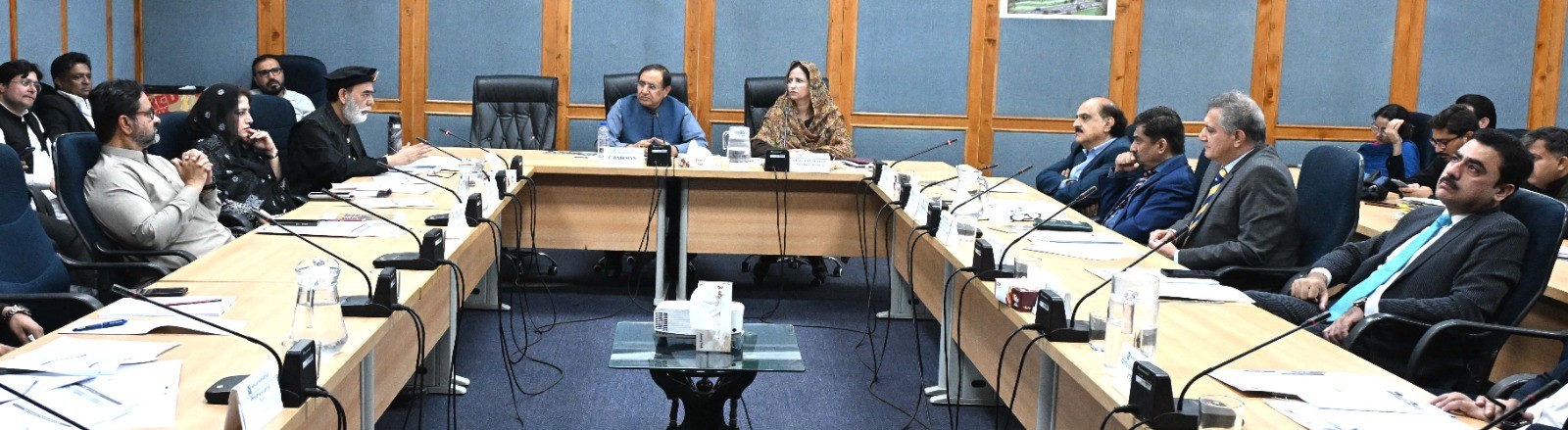
Press Release Title: Senator Dilawar Khan, Chairman Senate Standing Committee on Inter-Provincial Coordination (IPC) presiding over a meeting of the Committee at Parliament Lodges Islamabad
Press Release Date: 5th May, 2026
The Senate Standing Committee on Inter-Provincial Coordination met under the chairmanship of Senator Dilawar Khan to review a wide-ranging agenda, with a primary focus on the promotion of tourism in Chitral, institutional coordination, and national development programmes. The meeting was attended by Senator Talha Mehmood, Senator Rubina Qaim Khani, Senator Aimal Wali Khan and Senator Syed Kazim Ali Shah. The committee took up the agenda item regarding the promotion of tourism in Chitral, raised by Senator Muhammad Talha Mehmood, and received detailed briefings from officials of the Pakistan Tourism Development Corporation and the Ministry of Inter-Provincial Coordination. Officials informed the committee that Chitral is the largest tourism area of Khyber Pakhtunkhwa and has been declared a major hub for adventure and cultural tourism. The region includes key valleys such as Reshun, Garm Chashma, Laspur and Kalash, while Shandur Pass, Kalash Valleys and Chitral Gol National Park remain major attractions. The committee was briefed that after the 18th Amendment, tourism was devolved to the provinces, and in 2022, PTDC motels were transferred accordingly. A total of 19 tourism properties were handed over to Khyber Pakhtunkhwa, including five key motels in Chitral. These five properties have now been leased to Green Tourism under the Special Investment Facilitation Council, which operates under the Ministry of Defence, with the federal government to receive 10 percent of the profits under Revenue Sharing Agreement. Officials stated that 9.5 million domestic tourists visit Chitral annually, while foreign tourist numbers have shown a notable increase, rising from 1,500 in 2022 to 2,700 in 2025. The Kalash Valley Development Authority has also been established, and the region has been included in the provincial tourism master plan, with reported investment interest from Saudi Arabia and Kuwait. The committee was informed that several initiatives are underway to promote tourism, including activation of digital platforms, development of the “Visit Chitral Valley” website, preparation of brochures and maps, and collaboration with UNESCO. A “Responsible Tourism” campaign has also been launched to promote respect for local culture and environmental protection, particularly in the Kalash region. However, security concerns remain a challenge, as foreign tourists are required to obtain a No Objection Certificate before visiting Chitral. Senator Talha Mehmood expressed serious concern over the state of tourism infrastructure in Chitral. He highlighted that the lack of basic facilities remains a major obstacle to tourism growth. He stated that internet and social media access, now essential in the modern tourism landscape, are largely unavailable in the region. He pointed out that despite the global importance of Kalash culture and the Shandur Polo Festival, facilities for thousands of visiting tourists remain inadequate. He noted deficiencies in accommodation, food services and emergency healthcare. He revealed that hospitals in Chitral face a severe shortage of medical facilities, stating that even water is not available for surgical procedures. He further questioned the absence of functional dialysis machines across the district and disclosed that machines in Lower Chitral are also non-operational. Senator Talha Mehmood also raised alarm over road conditions, describing them as dangerous, with narrow routes flanked by rivers and mountains, increasing the risk of fatal accidents. He referred to incidents of vehicles falling into rivers and noted that access routes to Chitral remain closed for several months annually. He added that despite the Lowari Tunnel, travel difficulties persist, while flights remain limited, making the airport an unreliable alternative. He stated that reaching Shandur requires a difficult journey of 10 to 12 hours. He criticized the NOC requirement for foreign tourists, calling it a major hindrance, and questioned the delays in issuance. He suggested summoning officials from the National Highway Authority, Pakistan Telecommunication Authority and the Ministry of Interior to address infrastructure and security concerns. Drawing comparisons with Turkey, he highlighted the potential for generating billions in tourism revenue and questioned why Pakistan has not achieved similar foreign exchange gains. Senator Aimal Wali Khan endorsed these concerns and highlighted disparities in tourism development across the country. He compared Chitral and northern areas with destinations such as Murree, Nathia Gali and Naran-Kaghan, pointing out the lack of roads, hospitals and basic infrastructure in equally scenic regions. He termed the imbalance in development a serious concern and stated that claims of tourism promotion remain ineffective without fundamental facilities. He emphasized that internet connectivity, healthcare, accommodation and fuel availability are essential prerequisites for tourism. He observed that even local populations lack basic services, citing instances of women fetching water from distant locations. He criticized poor planning and overcrowding at tourist sites such as Kalam, and described the overall approach to tourism as inadequate. He stated that if addressed seriously, tourism could become a major source of national revenue. He also pointed to broader issues including security perceptions and Islamophobia as barriers to international tourism. The Chairman Committee, Senator Dilawar Khan, directed that a comprehensive review of provincial performance in tourism be presented, including reports from previous years. He emphasized the need for coordinated efforts and improved infrastructure. He stated that a dedicated future meeting would be held focusing exclusively on Chitral’s development and tourism potential. He announced that all relevant stakeholders would be summoned, including the Chairman PTA, Ministry of Interior, Ministry of Power, Ministry of Petroleum, Khyber Pakhtunkhwa health and public health departments, Ministry of Communications, Civil Aviation Authority, irrigation departments, Civil Aviation Authority, National Highway Authority, and DIG KP along with DPO Malakand district. A briefing on the challenges faced by the national hockey team during its tour to Australia, including payment of expenses, non-payment of allowances for 2023 events, and lack of official protocol, was deferred due to the absence of the mover. The Ministry of Inter-Provincial Coordination presented a proposal to revive and centralize the National Internship Programme. The committee was informed that the programme should be integrated across public sector organizations to ensure transparency, uniform policy and efficient resource utilization, with a revised implementation plan to be developed in consultation with relevant stakeholders. The committee received a detailed briefing on the Gun and Country Club, established in 2002 as a shooting facility for the 2004 SAF Games and later expanded into a full recreational complex. Officials outlined its facilities, including sports amenities, health and wellness services, dining and family areas. The Secretary IPC briefed the committee on membership and fee structures, noting that the club currently has about 2,000 members. A comparison with the Islamabad Club indicated relatively lower fees at the Gun and Country Club. Officials informed the committee that no special concessions are being offered, while steps are underway to improve facilities, including installation of modern equipment, expansion projects, and enhanced management practices to maintain service quality. The meeting concluded with a strong emphasis on addressing structural gaps in tourism infrastructure, improving inter-agency coordination, and ensuring accountability across sectors. The committee reiterated that Chitral holds significant potential as a global destination, provided that immediate and practical steps are taken to resolve longstanding challenges.