Science and Technology
Senate of Pakistan
News Detail
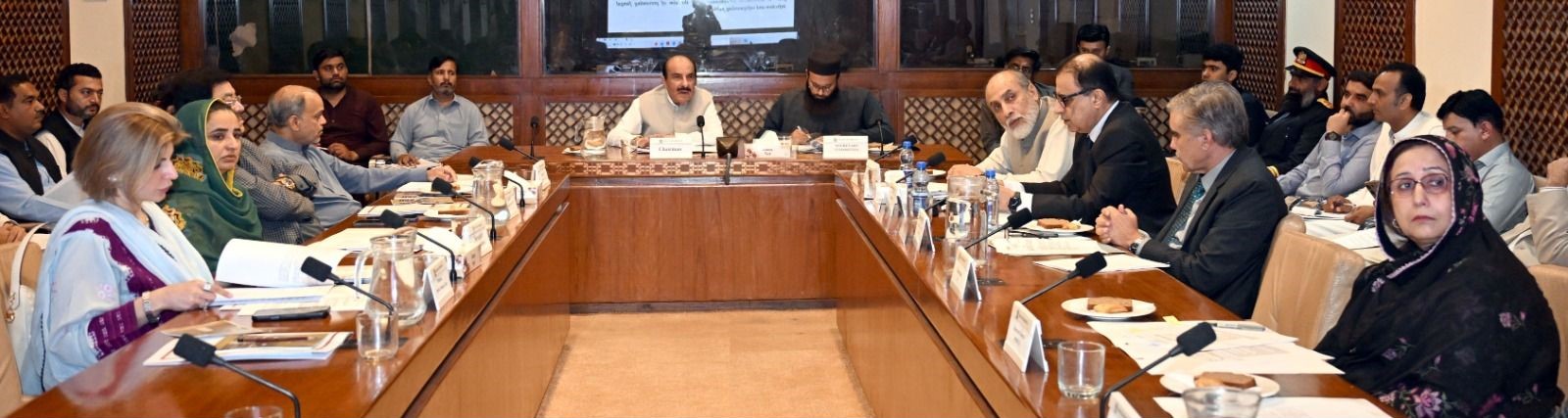
Press Release Title: Senator Kamil Ali Agha, Chairman Senate Standing Committee on Science and Technology Presiding over a Meeting Of The Committee at Parliament House Islamabad.
Press Release Date: 7th July, 2026
The Senate Standing Committee on Science and Technology met at Parliament House, today under the chairmanship of Senator Kamil Ali Agha. The meeting was attended by Senator Nadeem Ahmed Bhutto, Senator Husna Bano, Senator Samina Mumtaz Zehri, Senator Muhammad Aslam Abro and the Federal Minister for Science and Technology, along with senior officials of the ministry and relevant departments. The committee undertook a comprehensive review of legislative, regulatory and administrative matters relating to public health, food safety, institutional governance, organisational restructuring and appointments in organisations working under the Ministry of Science and Technology. The committee considered the Private Member Bill titled "The Islamabad Capital Territory Food Safety (Amendment) Bill, 2025", introduced by Senator Samina Mumtaz Zehri during the Senate sitting held on May 19, 2025. The proposed legislation seeks to protect public health by regulating the availability and consumption of high-sugar and high-caffeine beverages and soft drinks across Islamabad, particularly among children and adolescents. The bill aims to restrict the sale of such products, promote healthier alternatives and strengthen the implementation of the Islamabad Capital Territory Food Safety Act, 2021 to ensure the availability of safe and healthy food products. Speaking on the bill, Senator Samina Mumtaz Zehri expressed concern over the growing prevalence of diabetes and unhealthy dietary habits among children. She stated that Pakistan ranks first in the world in diabetes due to the absence of effective checks and balances. It was further observed that a 250ml bottle of soft drink contains approximately nine tablespoons of sugar, underscoring the serious public health implications of excessive sugar consumption. The committee was informed by the Secretary, Ministry of Science and Technology, that certain provisions of the proposed bill exceeded the legal ambit of the authority concerned and infringed upon the existing regulatory framework. The secretary suggested that instead of introducing a separate legal framework, the required amendments should be incorporated into the existing law. Representatives of the Pakistan Standards and Quality Control Authority informed the committee that standards governing such products had already been developed by the authority. They maintained that introducing another parallel set of standards would create duplication and legislative conflict. It was agreed that the bill would be revised and amended accordingly to avoid overlapping legislation while achieving its intended public health objectives. During the discussion, members also raised serious concerns regarding the widespread consumption of energy drinks, among children and adolescents. It was observed that these had become highly addictive and that, when mixed with certain readily available syrups, it could produce intoxicating effects similar to narcotic substances. Chairman Senator Kamil Ali Agha directed the relevant authorities to submit a comprehensive briefing on the ingredients used in these energy drinks along with a complete scientific analysis to enable the committee to deliberate on appropriate regulatory measures. The committee also reviewed measures to ensure timely inspection of betel nuts before distribution to consumers with the objective of preventing fungal contamination and safeguarding public health. The Federal Minister for Science and Technology informed the committee that betel nut is used for supari, with a major portion entering Pakistan through smuggling while the remaining quantity is imported legally. He stated that imported consignments are subject to plant protection requirements and laboratory testing. Chairman Senator Kamil Ali Agha stressed that laboratory testing should only be carried out through recognised laboratories operating under clearly defined criteria. It was briefed that legally imported betel nuts originate from Indonesia after pre-shipment testing through internationally recognised laboratories. The chairman further remarked that unless the issue of smuggled betel nuts is effectively addressed, the problem cannot be resolved. The minister informed the committee that the areas through which betel nuts are smuggled have become high-security zones, making enforcement operations increasingly difficult. Senator Nadeem Ahmed Bhutto stated that the betel nut business generates billions of rupees in revenue, but illegal smuggling continues to undermine the sector and disrupt lawful trade. Responding to queries regarding packed betel nut, the minister informed the committee that such products originate from India and enter Pakistan through road routes. He stated that the primary transport corridor runs through Quetta and Karachi via the M-8 Motorway to Sukkur. The committee was informed that previously all imported consignments underwent 100 percent quality testing within Pakistan. Under the revised import regime, however, 95 percent of quality testing is now carried out at the country of origin through recognised laboratories, supported by a health certificate valid for 15 days, while only five percent of consignments are subjected to post-arrival testing in Pakistan. Officials further briefed the committee that the revised system provides complete import data to the government and enables improved regulatory oversight. The Ministry of Commerce and the Ministry of National Food Security have jointly introduced measures eliminating discretionary powers of departments regarding laboratory testing. The committee was informed that the final notification governing the Standard Operating Procedures has been issued. Under the new mechanism, five percent of consignments undergo post-inspection. The Green Channel is fully automated, the Yellow Channel is applied where documentary deficiencies exist, while the Red Channel covers the five percent consignments selected for post-inspection under prescribed risk parameters. Officials cautioned that delays in inspection timelines significantly increase the risk of fungal contamination and other quality concerns. Chairman Senator Kamil Ali Agha maintained that all edible items should undergo 100 percent post-import testing. The minister informed the committee that approximately 270 betel nut shipments enter Pakistan annually. The chairman also noted that fake certifications have been detected internationally and observed that corruption within the relevant regulatory framework has become a serious concern. He reiterated the committee's recommendation that all edible items should be subjected to 100 percent post-inspection. It was further highlighted that nearly 80 percent of betel nuts remain unaccounted for due to illegal channels. The committee also reviewed serious administrative, legal, regulatory and governance concerns relating to the continuation of services of the Director General, Pakistan Halal Authority, beyond the expiry of the contractual tenure. Senator Muhammad Aslam Abro observed that a permanent appointment could not be made without approval from the Cabinet Division. The committee was informed that the previous Director General had originally been appointed for a three-year tenure with the approval of the Prime Minister and the Federal Government, subsequently received an extension, and completed the tenure. Officials clarified that the incumbent director general was pointed out by Senator Aslam Abro has not been appointed permanently but has only been assigned look-after charge to manage day-to-day affairs while the process for a regular appointment through open advertisement is underway. Chairman Senator Kamil Ali Agha observed that look-after charge should ordinarily be assigned to the next junior officer within the same department. Officials explained that there was a gap in the grading structure between the current incumbent and the next eligible officer. The officer concerned informed the committee that the position was not tenure-based and alleged that the cabinet had been misled regarding the grounds on which his services were terminated. The committee was also informed that the matter is currently sub judice before the court. The chairman directed the ministry to submit detailed written comments on the matter. He further advised that the appointment made on look-after charge should also be examined and reiterated that such arrangements should preferably be assigned to officers belonging to the same department. The committee also observed that the practice of assigning look-after charge has become common within the Ministry of Science and Technology. The committee also reviewed the latest position regarding the closure, merger and restructuring of organisations functioning under the administrative control of the Ministry of Science and Technology, including the Pakistan Council of Renewable Energy Technologies (PCRET), Pakistan Council for Science and Technology (PCST), National Institute of Oceanography (NIO) and Council for Works and Housing Research (CWHR). The Secretary, Ministry of Science and Technology, informed the committee that PCRET has been abolished following a decision of the Federal Government. He assured members that no employee had been dismissed, rendered unemployed or deprived of salary. He added that the Establishment Division is undertaking placement of affected employees while two organisations continue to operate. Chairman Senator Kamil Ali Agha expressed concern over the uncertainty faced by employees who had served for nearly 30 years. He stated that their future remained undecided and that prolonged uncertainty had adversely affected their professional reputation. He directed that their future should be decided without delay and that they should be adjusted in relevant government departments. The secretary informed the committee that PCST and NIO have been retained, while PCRET and CWHR have been abolished. All employees will continue to remain under the administrative control of the Ministry of Science and Technology until further placement The committee also conducted a detailed review of the appointment of heads of various organisations and authorities working under the Ministry of Science and Technology, including reasons for delays and the recruitment procedures adopted. The Secretary, Ministry of Science and Technology, informed the committee that appointments of eight heads of organisations have been regularised, while recruitment for the remaining positions is currently under process. He further stated that certain previous appointments could not be finalised as candidates failed to meet the eligibility criteria prescribed in the advertisements. Consequently, the requisition process has been revised and the vacancies are being re-advertised to ensure appointments strictly in accordance with the prescribed qualifications and requirements.