Privatization
Senate of Pakistan
News Detail
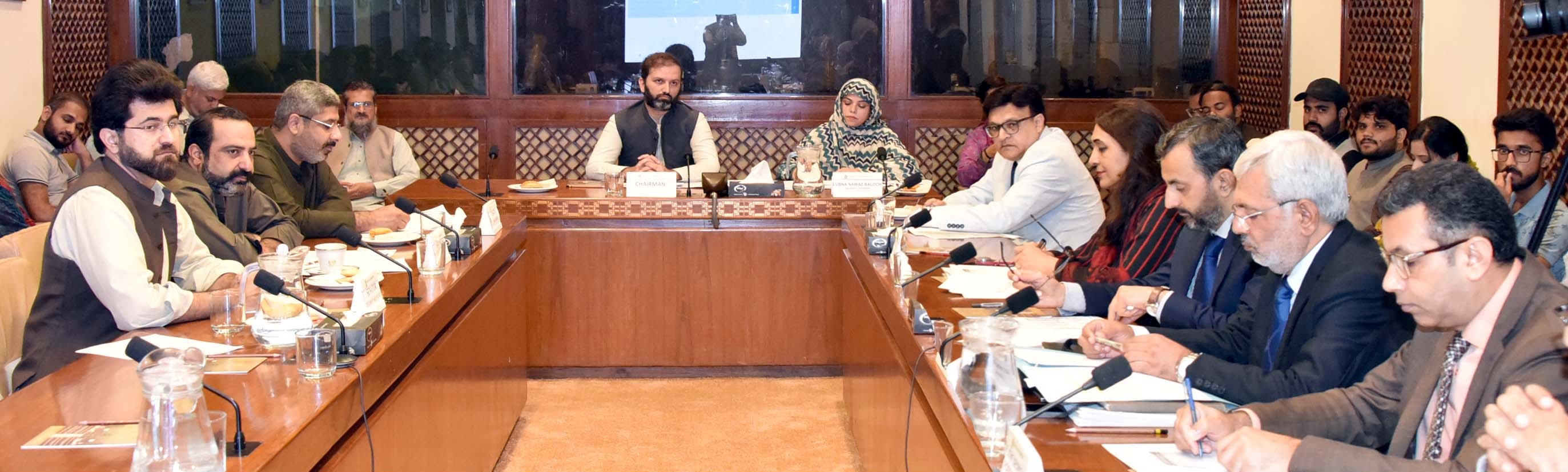
Press Release Title: Senator Dr. Afnan Ullah Khan, Chairman Senate Standing Committee on Privatization presiding over a meeting of the committee at Parliament House Islamabad.
Press Release Date: 1st September, 2025
The Senate Standing Committee on Privatization, chaired by Senator Dr. Afnan Ullah Khan, met today to review progress on key privatization initiatives including Pakistan International Airlines (PIA), power distribution companies (DISCOs), generation companies (GENCOs), and the Pakistan Minerals Development Corporation (PMDC). Senators Zeeshan Khanzada, Umer Farooq, and Asad Qasim attended the session. The agenda focused on the compliance status of previous recommendations, the impact of phasing out the single-buyer model, and the latest developments in the privatization of state-owned enterprises. Power Division officials informed the Committee that *Nandipur Power Plant and Guddu Power Plant are on the privatization list*, and under the way of privatisation process . “Eight important issues of Nandipur have been resolved, with only one pending related to the gas purchase and sale agreement,” officials said. They added that the government is still deciding whether to provide dedicated gas supply or continue the current arrangement of supplying gas only when available. Regarding Guddu Power Plant, officials noted that *four out of nine issues have been resolved*. The remaining disputes include land transfer, as the plant’s land is still registered under WAPDA. “WAPDA has already issued an NOC, and the transfer process is underway,” they said. Senator Dr. Afnan Ullah Khan underscored the importance of resolving the energy supply issue for privatization success. *“Gas availability in the country is a crucial concern. Until the investor has guaranteed gas, how will electricity be generated?”* he questioned. He further noted, *“A long-term gas supply agreement will be key for privatization, but the preparations of the Power Division still appear incomplete.”* Officials from the Power Division confirmed that Nandipur will receive LNG supply while Guddu will be supplied gas from the Kandkot field. They also revealed that a *special market operator company has been established* to open up the power purchase and sale market, with 3,000 MW expected to be traded in the first phase. On DISCOs, officials stated that *three companies are currently on the privatization list. The Privatization Secretary highlighted, *“The financial advisor engaged for DISCOs has completed significant groundwork. The government has decided at the highest level that it will not do business anymore.”** Senator Zeeshan Khanzada questioned the strategy, asking, *“Why is the government selling profitable companies in the first phase?”* The Privatization Secretary responded, *“Investors are naturally more interested in profitable companies. Even if government entities were given away for free, it would still be the right decision because they may not remain profitable in the future.”* On PIA, officials disclosed that *privatization is expected by November 2025. The Secretary informed the Committee that **four companies are participating, and they will need to form consortiums with established airlines to operate PIA. Two applicants were disqualified for not meeting standards. Senator Zeeshan Khanzada raised concerns over PIA’s **Rs. 650 billion debt, to which Chairman Afnan Ullah Khan suggested that **PIA’s two hotels could be sold to offset liabilities*. The Committee also discussed PMDC’s performance. CFO of PMDC reported significant progress in coal and salt mining, with new investments in value-added salt and soda ash production. However, Senator Umer Farooq strongly opposed its privatization, stating, *“This company benefits Balochistan immensely. It is profitable and should not be privatized.”* Chairman Afnan Ullah Khan clarified that today’s agenda was only to review the corporation’s performance, not to decide on its privatization. Concluding the session, the Committee emphasized the need for clarity on energy supply agreements, debt restructuring, and protection of profitable state assets before moving forward with privatization.