News Detail
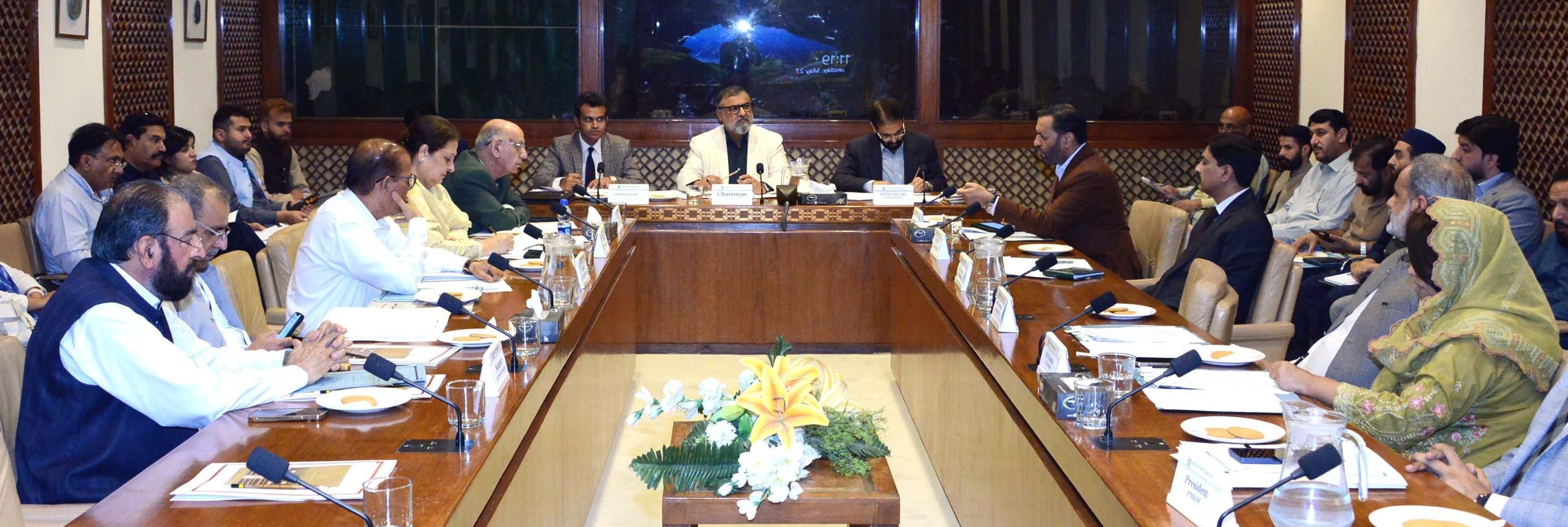
Event Title: Senator Amir Wali Uddin Chishti Chairman Senate Standing Committee on National Health Services, Regulations and Coordination Presiding over a Meeting of The Committee at Parliament House, Islamabad
Event Date: 2025-05-27
A Meeting of the Senate Standing Committee on National Health Services, Regulations and coordination was held at Parliament House under the Chairmanship of Senator Amir Waliuddin Chishti. The meeting was attended by Senators Syed Masroor Ahsan, Irfan-ul-Haque Siddique, Fawzia Arshad, Jan Muhammad, Haji Hidayatullah, Syed Mustafa Kamal, Federal Minister for Health and senior management from the Ministry/relevant departments.
The meeting was held to discuss complaint against on duty medical Officer (CMO) of Federal Government Services Hospital, Islamabad. Today Senator Syed Masroor Ahmed expresses serious concern about the dire condition of the Polyclinic hospital and emphasizes the need for immediate attention and improvement. He shared his personal observations during a visit, where he witnessed the substandard conditions and expressed concern over the inadequate state of healthcare services. Furthering to this, he pointed out that patients are advised to obtain prescribed medications from outside pharmacies. The Minister of National Health Services, Mustafa Kamal, informed the Committee that the city is served by two major hospitals and thirty Basic Health Units (BHUs). However, he informed that these facilities are experiencing significant strain, with nearly 70% of the population relying on them for medical care. He also noted that many individuals, even those suffering from common ailments such as headaches, are visiting these hospitals despite being able to afford private healthcare, further exacerbating the burden on public health institutions.
Meanwhile, he also revealed that patients from Azad Jammu and Kashmir (AJK) and Khyber Pakhtunkhwa (KPK) comes to Islamabad for treatment in these hospitals. The hospitals which can accommodate approximately 3,000 patients, are now serving up to 30,000 Patients. Which cause immense pressure on their resources and services.
Mustafa Kamal also informed the committee that we have identified a viable solution to address the growing pressure on public healthcare facilities. He announced plans to initiate a public-private partnership model with the involvement of the private sector on a non-profit basis. He added that work on this initiative is expected to commence within the next 15 to 20 days. The Minister further briefed the committee that a Jinnah Medical Complex is being established in Islamabad, which will also the one of the largest medical research centers in the region.
During the course of discussion, the Chairman Committee inquired about the underutilized hospital buildings constructed during the COVID-19 pandemic with a 266-bed capacity. He questioned why such existing infrastructure was not being utilized effectively. The Minister stated that steps are being taken to bring those buildings into operational use. He also shared that several extensions of Pakistan Institute of Medical Sciences (PIMS) are currently under development across different areas of Islamabad, many of which are nearing completion.
Subsequently, Chairman recommended the establishment of an additional hospital in Islamabad, noting that despite the city’s population having grown to approximately 2.6 to 2.7 million, it continues to be served by only two major public hospitals. He emphasized the urgent need to expand the healthcare infrastructure in line with the city’s increasing population demands.
The Committee raised concerns regarding alleged corruption and mismanagement in the Pakistan Nursing Council. During a discussion, the federal Minister for Health, strongly criticized the Pakistan Nursing Council (PNC), describing it as a "mafia-like" entity. He stated that while he holds certain verbal authority over the institution, he lacks the formal, written powers required to implement substantial reforms. He added that the institution has been severely mismanaged and has suffered extensive damage due to internal dysfunction. The Chairman Committee and Members extended their full support to the Minister, encouraging him to bring forward any proposed legislative amendments necessary to reform the Pakistan Nursing Council. They assured him of their cooperation in ensuring accountability and institutional improvement. The members unanimously agreed that they stand ready to assist in any efforts aimed at restoring transparency and efficiency within the Council.
Additionally, the Minister suggested an in-camera meeting to present a detailed way forward, outlining actionable steps to transform and improve the functioning of the Pakistan Nursing Council.
The Committee was briefed on plan by Drug Regulatory Authority of Pakistan (DRAP) concerning misleading formula milk advertisement that DRAP Act, 2012 and Alternative Medicines and Health Products (Enlistment) Rules, 2014 defines 'baby milk and food' as Health and OTC Products (non-drugs). Furthermore, they told that the matter of dual regulatory framework for the regulation of baby milk and food was agitated at the forum of SIFC and BOI since February 2024 as same can also be regulated by provincial food departments as per their legislation.
After several meetings at SIFC and BOI, it was decided to exclude the regulation of the Baby Milk and food from the domain DRAP and it will be exclusively regulated by provincial food departments and baby milk and foods for special medical needs and treatments will be regulated by DRAP only. Resultantly amendments in The Alternative Medicines and Health Products (Enlistment) Rules, 2024 has been vetted by the Law and Justice Division and summary is being submitted to CCLC for approval of Federal Cabinet. Following this, after a comprehensive briefing the Committee decided to discuss this in forthcoming in-camera meeting.
During the committee meeting, it was noted that the Vice Chancellor of the Health Services Academy had been officially summoned. However, he failed to appear before the Committee and taking serious notice of his absence, the Chairman Committee recommended that the matter be referred to the Privilege Committee to determine the reason for his non-compliance. The Federal Minister for Health also expressed concern over the Vice Chancellor's absence, stating that he should have been present at the meeting and no one in the committee was informed of the reason behind the Vice Chancellor’s absence.