News Detail
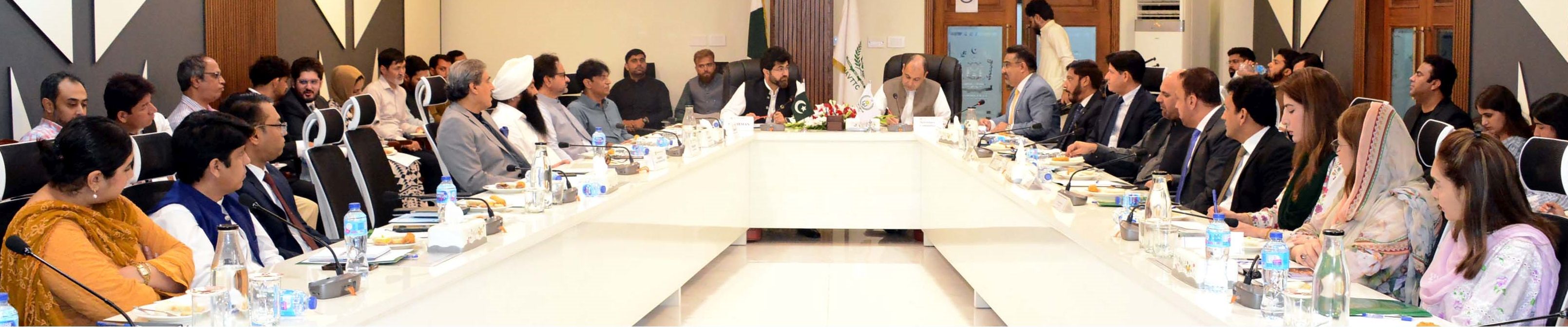
Event Title: Senator Zeeshan Khanzada, Chairman Senate Standing Committee on Overseas Pakistanis and Human Resource Development presiding over a meeting of The Committee at National Vocational & Technical Training Commission (NAVTTC), Islamabad
Event Date: 2025-07-10
A meeting of the Senate Standing Committee on Overseas Pakistanis and Human Resource Development was held for the first time at the headquarter of the National Vocational and Technical Training Commission (NAVTTC), under the Chairmanship of Senator Zeeshan Khanzada.
The committee was held to witness various vocational and technical training programs/courses imparted by NAVTTC for employability and job opportunities for skilled/semi-skilled professionals as well as intending emigrants, to evaluate their effectiveness and to ensure the programmes designed for emigrants are at par with the demand of the national and international market needs.
During the meeting, Chairman of the Committee, Senator Zeeshan Khanzada, expressed concern over the limited number of skilled individuals in the country, pointing out that only 2 million people out of a population of 70 million are skilled. He remarked that the labour force per capita is alarmingly low, and questioned NAVTTC’s role in addressing this issue. NAVTTC briefed that the Pakistan’s labour force participation rate stands at 44.9% (2024–25) with regional counterparts such as Bangladesh (58.3%) and Vietnam (73.69%).
Furthermore, NAVTTC briefed the Committee on key findings regarding employment outcomes of skilled individuals. According to the data shared, the overall employment rate stands at 53%, with 38% of employed individuals earning more than PKR 50,000 per month, 18% earning between PKR 31,000 and PKR 50,000, and 27% earning up to PKR 30,000. Additionally, 17% of respondents declined to provide income information. They further briefed that students will be given loan by Punjab Bank & National Bank on the guarantee of NAVTCC.
Following this, NAVTTC showed International employability Comparison of skill training, it was shared that according to a tracer study (2018–2020) of public training institutes, the employment rate in Sri Lanka stood at 54.5% (1 year after completion of training). In Bangladesh, according to data from 2020–2021, the employment rate was 39% (2 years after completion of training). For Pakistan, according to 2025 data, the employment rate was 53% within (6 months to one year after completion).
Moreover, NAVTTC Present key findings regarding employment types, stating that 64% of skilled workers are engaged in full-time wage employment, 14% in part-time wage employment, 18% in self-employment, and 4% in daily wage or other forms of employment. Sector-wise employment distribution highlighted Information Technology (32%) as the leading sector, followed by Construction and Energy (12%), and Banking and Finance (6%). A total of 25,079 skilled workers have gone abroad in the last four years.
The Chairman Committee stressed the need for NAVTTC to intensify its efforts and enhance the effectiveness of skills training to improve employability outcomes both domestically and internationally. It was also raised during the Committee meeting that no recent labour survey has been conducted, the last one took place in 2021. It was emphasized that the upcoming survey should be based on the census not on censor.
NAVTTC informed the Committee that quotas are fixed for all provinces, and if a province is unable to fulfill its quota, it is reallocated to another province. On this, Senator Zameer Ghumro remarked that this either reflects a disparity or a lack of responsibility on the part of the institutions, which should ensure that the quota is fulfilled from within the respective province, and re-advertise the positions if necessary. Senator Ghumro further directed that the province-wise details of training partners and sector wise finances details be submitted in the next meeting.
The members also highlighted that there is still very low awareness about the training programs being offered by NAVTTC, especially in rural areas and other regions where people remain unaware due to the lack of proper outreach and publicity.
The Chairman Committee stated that there is a large population of labourers in our country, yet no training has been arranged for them. He emphasized that the educated population is relatively small, while the number of labourers is significantly high, and their needs should be considered. The Chairman recommended that, in addition to IT, NAVTTC should focus on capacity building in other sectors such as Heavy Vehicle drivers, Electric Vehicle (EV) Divers and mechanics, welders, and various other fields. The Chairman of the Committee further proposed that maximum efforts should be made to enhance training and development in the agriculture and livestock sectors, highlighting their significance as essential pillars of the national economy.
The meeting was attended by Senators Zamir Hussain Ghumro, Gurdeep Singh, Syed Kazim Ali Shah, Nasir Mehmood and senior management from the Ministry/relevant departments.