News Detail
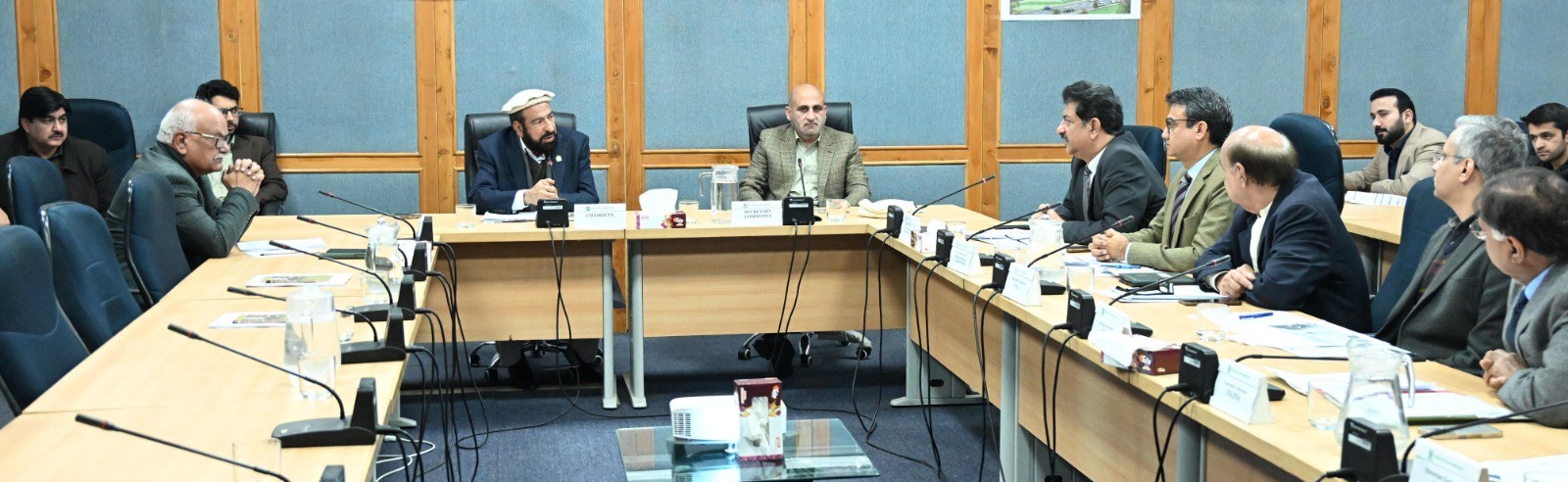
Event Title: Senator Hidayatullah Khan, Chairman Senate Standing Committee On National Heritage and Culture Presiding over a Meeting of The Committee at Parliament Lodges, Islamabad.
Event Date: 2026-01-27
Senate Standing Committee on National Heritage and Culture Reviews Institutional Performance and Policy Directions
The Senate Standing Committee on National Heritage and Culture met here at the Parliament Lodges under the chairmanship of Senator Hidayatullah Khan. The meeting focused on an in-depth review of the role, responsibilities, institutional capacity, and policy outlook of the Ministry of National Heritage and Culture and its attached departments.
The Secretary, Ministry of National Heritage and Culture, briefed the Committee on the mandate of the division, sanctioned posts, current human resource strength, details of autonomous bodies and attached departments, and the annual budget allocations.
The Committee was given a detailed presentation by the Director General, National Institute of Folk and Traditional Heritage (Lok Virsa), outlining the institute’s responsibilities, the number of cultural shows conducted at national and regional levels during the past two years, and utilization of its annual budget.
A separate briefing was presented by the Director General, Department of Archaeology and Museums (DOAM), covering the department’s core functions, employee strength, and financial allocations.
During the meeting, the Committee expressed concern regarding matters related to the Quaid-e-Azam Mazaar Management Board (QMMB). The Chairman directed the Secretary of the Ministry to present an annual calendar of cultural events. The Committee also sought details of international cultural visits, and the Ministry informed members that cultural exchanges were conducted in the previous year with countries including China, Japan, Korea, and Kuwait.
Snator Sarmad Ali raised a question regarding financial assistance for retired or financially constrained artists. The Ministry informed the Committee that financial support mechanisms for artists are in place. Senator Sarmad Ali also noted the historical role of earlier governments in establishing major cultural and heritage institutions. The Secretary acknowledged the contribution of Senator Sarmad Ali and the Pakistan Peoples Party in preserving key cultural institutions.
Senator Syed Waqar Mehdi inquired about financial contributions from provinces to federal cultural institutions, including the Quaid-e-Azam Management Board. Committee members also emphasized that the National Archives should function under the Ministry of National Heritage and Culture.
The Committee expressed serious concern over limited gallery space at the National Museum in Karachi. The Ministry informed the Committee that approximately 10,000 artifacts are on display, while over 90,000 artifacts remain in storage due to space constraints. Members stressed the need for a purpose-built National Museum in Islamabad with sufficient capacity to display Pakistan’s complete cultural heritage.
The Committee also discussed the issue of the Shemza painting donated by Mr. Anwar Shemza. Ministry officials stated that the paintings were taken back in 2020 under executive orders issued during a previous government.
The Chairman emphasized the urgent need for a National Museum building. On the issue of stolen artifacts, the Ministry informed the Committee that since devolution under the 18th Constitutional Amendment, no new cases have been reported. Previously, valuable artifacts from Gandhara and Mohenjo-daro were illegally smuggled abroad.
Chairman Senator Hidayatullah Khan sought details of international Memoranda of Understanding for the recovery of smuggled artifacts. The Ministry stated that several MoUs have been signed with European and Asian countries, resulting in the repatriation of many stolen artifacts. The Chairman underscored the importance of strengthening cultural diplomacy and expanding engagement with foreign missions to safeguard national heritage.
The Committee reviewed the status of Pakistan’s six UNESCO World Heritage Sites and urged the Ministry to increase the number of registered sites. Members also discussed archaeological excavation activities, noting ongoing work by American and German teams in Sindh, and a proposal by Japanese experts for exploration of Shah Allah Ditta caves.
The Committee emphasized the need for annual cultural exhibitions in all provinces, including Azad Jammu and Kashmir and Gilgit-Baltistan. Discussions were also held on the audio-visual archives, Lok Virsa funding, international cooperation, Bag-e-Jinnah, and the digital gallery at Sir Syed Memorial Hall, Islamabad.
The meeting concluded with the Committee expressing concern over human resource capacity and funding constraints, and reiterating its commitment to strengthening national heritage institutions through policy oversight and coordinated planning.