News Detail
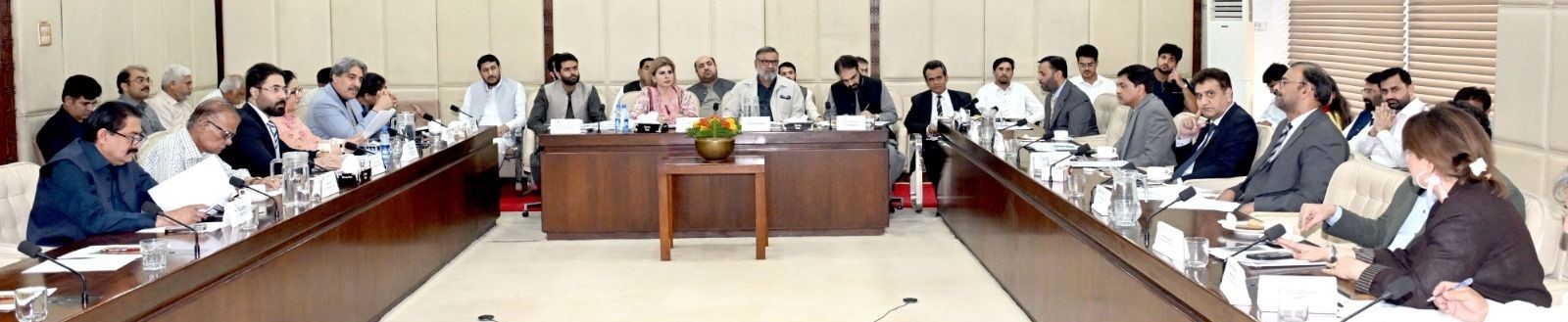
Event Title: Senator Amir Waliuddin Chishti, Chairman Senate Standing Committee on National Health Services, Regulations and Coordination and Senator Samina Mumtaz Zehri, Chairperson Senate Functional Committee on Human Rights jointly presiding over a joint meeting of the both committees at Parliament House Islamabad
Event Date: 2026-07-09
Joint Senate Committees Discuss National Population Coordination Bill, Stress Need for Permanent Legal Framework
The Joint Meeting of the Senate Standing Committee on National Health Services, Regulations and Coordination and Senate Functional Committee on Human Rights was held today at Parliament House, Islamabad, under the joint chairmanship of Senator Amir Waliuddin Chishti, Chairman Senate Standing Committee on National Health Services, Regulations and Coordination, and Chairperson of the Senate Functional Committee on Human Rights, Senator Samina Mumtaz Zehri. The meeting deliberated on matters relating to public health, human rights, and legislative reforms, with participation from representatives of the concerned ministries and relevant stakeholders.
The meeting was attended by Senators Qurat-ul-Ain Marri, Anusha Rahman Ahmed Khan, Shahzaib Durrani, Nasir Mehmood, Poonjo Bheel, Atta Ul Haq, Syed Masroor Ahsan, Minister for National Health Services, Regulations and Coordination Syed Mustafa Kamal and senior officials from the relevant Ministries and departments.
The Minister for National Health Services, Regulations and Coordination, Syed Mustafa Kamal briefed the Joint Committee that effective population management is essential for national development, with direct implications for health, education, employment, food security, and environmental sustainability. The Minister further apprised the Committee that the National Population Council has already been constituted under the chairmanship of the Prime Minister. The Council comprises the Chief Ministers of all provinces, the Prime Minister of Azad Jammu and Kashmir, the Chief of Army Staff, and 11 key Federal Ministers.
Further, He stated that rapid population growth remains one of Pakistan's most pressing challenges and emphasized that the Prime Minister has accorded the issue the highest priority. He observed that the existing resource distribution mechanism under the National Finance Commission (NFC) Award is largely population-based, which creates challenges for provinces in pursuing effective population management. He further informed the Committee that high prices of contraceptives have remained a major barrier to family planning. He added that, following extensive consultations with the International Monetary Fund (IMF), the Government succeeded in securing a substantial reduction in taxes on contraceptive products in the current budget to improve affordability and support national population control efforts.
During the discussion, Senator Qurat-ul-Ain Marri inquired whether any legislation currently exists to govern population management. Officials informed the Committee that the National Population Council is presently functioning as a coordination forum and does not have statutory status. It was also highlighted that dedicated legislation is essential to provide the Council with a permanent legal framework and ensure continuity in national population policy irrespective of changes in government. The Committee emphasized that population management requires sustained national commitment and institutional continuity. The Chairperson Committee endorsed the proposal, observing that enacting such legislation is the need of the hour to ensure a coordinated and long-term approach to addressing the country's population challenges.
Moreover, Officials from the National Population Council informed the Committee that Pakistan currently has no dedicated legislation on population management and that the Council is functioning as a coordination forum rather than a statutory body. They further stated that, for the first time, the Chief of Army Staff of Pakistan has been included as a member of the Council, reflecting the importance being accorded to population management as a national priority. Officials briefed the Committee that a meeting with the Chief Ministers of all provinces is scheduled to be held later this month to deliberate on population-related challenges and strengthen coordination on the issue. They emphasized that Pakistan is currently facing a population emergency and stressed the need for a coordinated national response.
Following this, Committee Member urged to revisit the proposed draft and come back with comprehensive legislation that adequately addresses the constitutional and legal aspects of population governance. She observed that there is a broad consensus on the importance of addressing population growth and emphasized that a dedicated constitutional and legislative framework is essential to ensure continuity and effective implementation of population policies.
Additionally, Chairperson Committee, observed that no objections had been raised during the Committee's previous meeting on the proposed legislation. She emphasized that the objective of population management should not merely be to reduce birth rates but also to ensure the well-being, protection, and proper upbringing of children. Highlighting concerns over child begging, child abuse, sexual exploitation, human trafficking, and other forms of violence against children, she stressed that these social challenges underscore the need for effective population planning and stronger child protection measures. She further remarked that limited access to basic services, including education, healthcare, electricity, and clean water, places additional strain on families and public resources. The Chairperson also expressed the view that, given the national importance of the issue, population management should receive coordinated attention at the federal level despite its devolution under the 18th Constitutional Amendment.
After detailed deliberations, Chairperson and Chairman Committee directed the relevant ministries and concerned officials to hold consultative meetings and further refine the proposed legislative framework through mutual consensus. The Joint Committee deferred its decision on the proposed Bill for the time being and decided to convene another meeting later this month to continue deliberations after receiving the outcome of inter-ministerial consultations.