News Detail
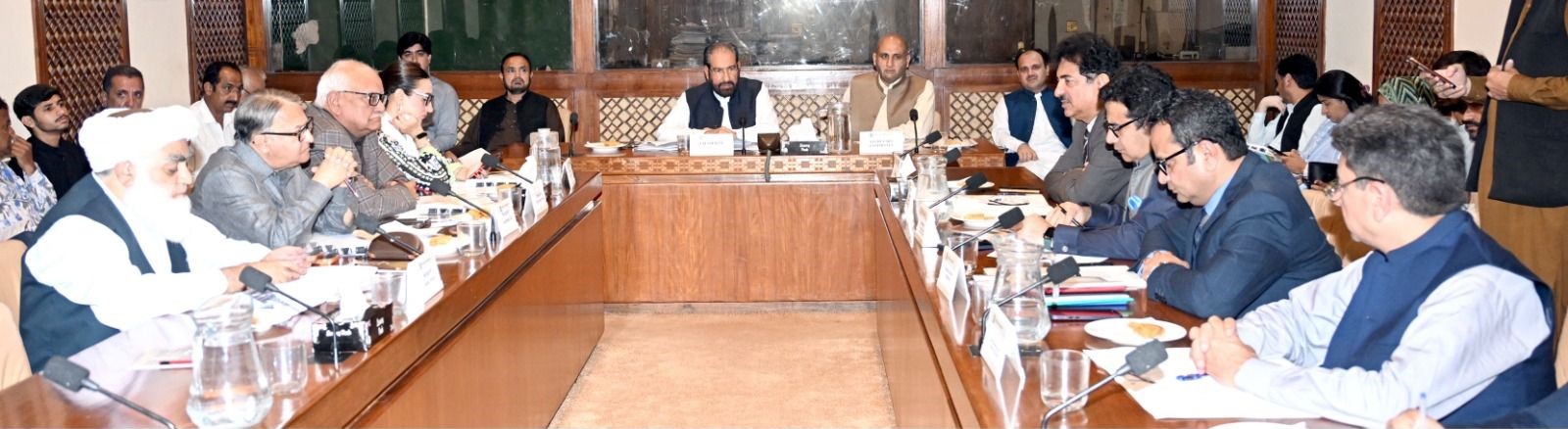
Event Title: Senator Hidayatullah Khan, Chairman Senate Standing Committee on National Heritage and Culture presiding over a meeting of the committee at Parliament House, Islamabad.
Event Date: 2026-07-27
SENATE STANDING COMMITTEE ON NATIONAL HERITAGE AND CULTURE REVIEWS UNESCO CONCERNS, HERITAGE CONSERVATION, AND REPATRIATION OF STOLEN ARCHAEOLOGICAL ARTEFACTS
The Senate Standing Committee on National Heritage and Culture met today at Parliament House under the chairmanship of Senator Hidayatullah Khan to review matters relating to the conservation of Pakistan's cultural heritage, UNESCO's observations regarding archaeological sites at Mohra, Moradu, and Sirkap and the repatriation of smuggled archaeological artefacts from the United States. The meeting was attended by Senators Abdul Wasay, Bushra Anjum, Sarmad Ali, Syed Waqar Mehdi, Secretary National Heritage and Culture, and senior officials of the concerned departments.
The Committee first received a detailed briefing from the Secretary, National Heritage and Culture regarding reservations communicated by UNESCO over conservation measures undertaken by the Directorate General of Archaeology, Punjab, at the archaeological sites of Mohra Moradu and Sirkap in Taxila.
Furthermore, Officials informed the Committee that following the 18th Constitutional Amendment, heritage conservation became a provincial subject and the Government of Punjab initiated conservation work at the sites. They explained that UNESCO had sought additional information regarding the restoration work, which had already been provided by the Punjab Government. Officials further stated that no further concerns had been communicated after the requested information was shared and that the restoration work was being carried out in accordance with UNESCO's conservation guidelines.
During the briefing, officials informed the Committee that the conservation programme for the Taxila World Heritage Site, including Mohra Moradu and Sirkap, had been designed in accordance with the recommendations of UNESCO/ICOMOS and the Urban Unit. They stated that the conservation strategy follows internationally recognised principles, including reversibility, distinguishability, material compatibility, masonry consolidation, scientific repair of deteriorated joints, traditional protective wall capping and drainage improvements to ensure the long-term preservation of the archaeological remains.
The Committee was informed that Pakistan presently has six UNESCO World Heritage Sites, while dossiers for twenty-four additional sites have been prepared and submitted for future inscription. Officials explained that UNESCO normally considers only one nomination from a country each year. They further informed the Committee that Pakistan has requested UNESCO to accord priority to its pending nominations.
During the discussion, Senator Syed Waqar Mehdi sought details of UNESCO's objections contained in the correspondence. Officials explained that the concerns mainly related to the construction material used during conservation works, the methodology adopted for rebuilding certain walls, and the height of reconstructed structures. They informed the Committee that these issues had been addressed and comprehensive documentation had been submitted to UNESCO. The Committee was also informed that scientific micro-cleaning and consolidation work had been undertaken while ensuring compliance with international conservation standards.
Following this, the Committee discussed the development of Taxila as a heritage city and reviewed ongoing conservation projects. Officials informed members that approximately Rs.100 million had already been utilised during the current year on conservation activities, while additional development initiatives, including an open-air museum and improved visitor facilities, were under consideration. They also informed the Committee that coordination was being maintained with the provincial governments wherever archaeological sites extended across provincial boundaries.
Senator Bushra Anjum stressed the need for stronger federal oversight over heritage conservation despite provincial responsibility after the 18th Amendment. She also emphasised the importance of developing proper tourism infrastructure, including accommodation facilities, visitor services and a sustainable business model to generate tourism revenue while protecting heritage sites. She urged that all conservation work should strictly adhere to UNESCO standards and avoid the use of inappropriate materials.
The Committee directed the Ministry to share UNESCO's formal response with the Committee once received and recommended that members undertake a visit to the Taxila archaeological sites to review the conservation work firsthand.
The Committee then considered a detailed briefing on the smuggling of Pakistani archaeological artefacts to the United States and their subsequent repatriation.
Officials informed the Committee that under bilateral cooperation with the United States, a total of 513 archaeological artefacts had been repatriated to Pakistan. The recovered objects, mainly belonging to the Gandhara civilisation, had been seized by US authorities after being smuggled through illegal channels over several decades. Officials stated that the artefacts were invaluable national treasures reflecting Pakistan's rich civilisational heritage and were now in government custody.
The Committee was informed that plans were underway to establish a new museum for the preservation and display of the recovered artefacts and that land acquisition for the project was being pursued in coordination with the Capital Development Authority (CDA). Officials also stated that public-private partnership options were being explored for the museum's development.
Moreover, Members sought details regarding investigations into the smuggling network, individuals involved, and the total number of missing artefacts. The Committee directed the Ministry to submit a comprehensive report covering the inquiry, recovery process, estimated value of the artefacts, and the status of ongoing investigations.
Additionally, Committee was further informed about concerns regarding the reported demolition of a historic Mughal-era arch near Rohara Village for a housing development. The Chairman directed the Ministry to collect complete information on the matter and present a detailed briefing at the Committee's next meeting.
The meeting concluded with the Chairman reaffirming the Committee's commitment to safeguarding Pakistan's cultural and archaeological heritage through effective conservation, stronger institutional coordination, enhanced tourism planning and strict measures against the illegal trafficking of antiquities.