News Detail
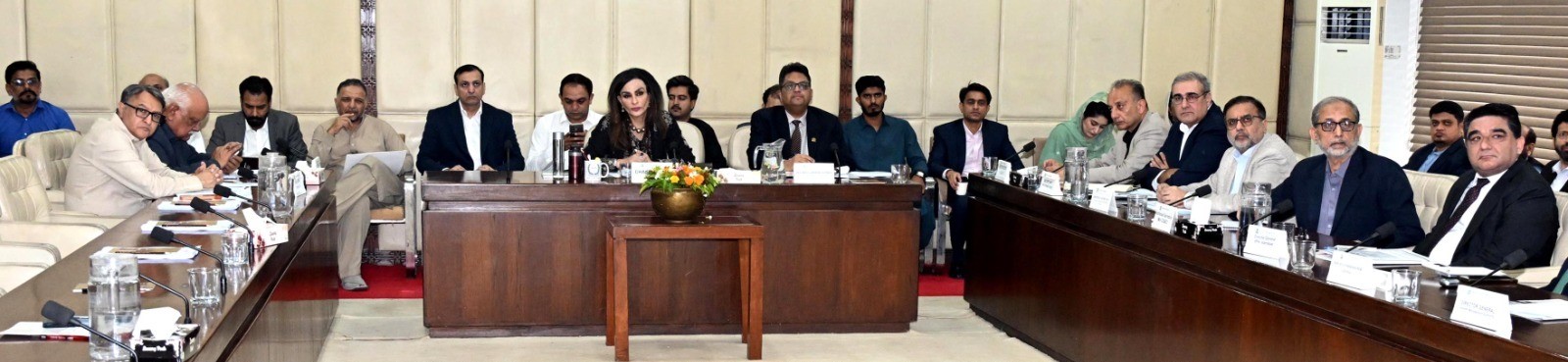
Event Title: Senator Sherry Rehman, Chairperson Senate Standing Committee on Climate Change & Environmental Coordination presiding over a meeting of the committee at Parliament House Islamabad
Event Date: 2026-09-22
Sherry Rehman Calls for Urgent Action on GLOF Risks, Glacier Monitoring and Plastic Law Enforcement
The Senate Standing Committee on Climate Change, chaired by Senator Sherry Rehman, held a detailed briefing on the latest developments regarding Glacial Lake Outburst Floods (GLOFs), Pakistan’s endangered cryosphere and associated emerging challenges.
During the briefing on GLOFs and glacial melt, the committee was informed that Pakistan has an exceptionally high exposure to glacier-related risks. The committee was briefed on the growing threat posed by unstable glacial lakes.
Senator Sherry Rehman stressed “Pakistan has 13,032 glaciers and more than 3,000 glacial lakes. Historical records note that the country has experienced around 131 recorded GLOF events, 33 glacial lakes in Pakistan are dangerous and could burst suddenly. A glacial lake outburst could put 7.1 million people in Gilgit-Baltistan and Khyber Pakhtunkhwa at risk.“
Senator Sherry Rehman said that Pakistan must move beyond general assessments and develop a comprehensive, countrywide system for monitoring its glaciers and glacial lakes.
“We are talking about a very serious and immediate risk. Communities are directly impacted by GLOFs, and many of these glacial lakes are effectively ticking time bombs. Attabad Lake is one example of the scale of devastation that can follow,” she said.
She noted that Pakistan has been discussing an estimated 16 percent rate of glacial retreat and stressed that the country needs current, reliable data covering all its glaciers rather than information limited to individual mountain ranges.
“We need to know at what speed our glaciers are receding. Does anyone in the relevant authorities have the exact current figure for the country? We need the latest statistics and data,” Senator Rehman said.
The Director General, Provincial Disaster Management Authority (PDMA), briefed the Committee that protective bunds had been constructed and automatic monitoring systems were in place. He informed the Committee that a study conducted by SUPARCO and the Government of Khyber Pakhtunkhwa had identified 24 glacial lakes in the region, of which five were categorized as high-risk while the remaining lakes were considered relatively low-risk. He further stated that climate-related incidents during 2026 had damaged 535 houses and 31 bridges.
The committee was informed that GLOF-related projects have been undertaken with UNDP support, including GLOF-I from 2011 to 2016 and GLOF-II from 2017 to 2024. Senator Rehman observed that the geographical coverage of such interventions remains limited and called for stronger institutional coordination among relevant agencies, including SUPARCO, NDMA, PMD and provincial authorities.
She said the challenge could not be treated solely as either a climate finance issue or a disaster management issue.
“This is both a climate finance problem and a disaster management problem. There are serious institutional gaps and cooperation between institutions remains far too limited. We need an integrated response rather than institutions working in parallel,” she said.
Senator Rehman also raised concerns over the functioning of sensors and SIM-based early warning systems installed in vulnerable areas, stressing the need for reliable real-time information and communication.
“Please tell us what measures you are taking and how they are actually working. What lessons have you learned? Early warning systems are only useful if they function when people need them,” she said.
She stressed that Pakistan could not afford a routine, business-as-usual response at a time when the country was facing climate, economic, fuel and geopolitical pressures.
“Everyone knows we are in a crisis. We have suffered losses of more than billions of dollars, and instead of moving forward, we are moving backwards. Tell us what low-cost solutions you can provide and, most importantly, what you are doing to protect your people,” Senator Rehman said.
“I should not have to tell you what the solutions are. We need proactive measures, creative solutions and clear lessons from countries such as Nepal, particularly from their experience with floods. This cannot be a business-as-usual presentation or a business-as-usual committee response,” she added.
The committee was briefed on key challenges including the absence of a unified glacial registry, the need for periodic monitoring of glacial lakes, assessment of lake volumes and dam stability, cloud cover and satellite blind spots, and sustained financing.
Recommendations presented to the committee included establishing a unified glacier inventory, expanding satellite and drone-based monitoring, using artificial intelligence for glacier and risk monitoring, establishing community-based early warning systems, and strengthening governance, financing and partnerships.
Senator Rehman called for these recommendations to be converted into clear and time-bound action points.
“Share the points that need to be listed as action plans. We do not need another structure or authority running parallel to the ministry. We need coordination, accountability and implementation,” she said.
Minister of Climate Change Musadik Malik briefed the committee that GLOFs were fundamentally different from conventional floods, noting that smaller structures may not be able to withstand the force and debris associated with GLOF events. He stressed the need for safe zoning, integrated data systems and stronger regional data-sharing mechanisms.
The committee was also informed that of the early warning systems planned since 2017 to 2026, 34 early warning systems have been provided, while another 284 systems will be supplied within six months while the remaining systems were being completed. The Minister acknowledged the need for better modalities and supervision, noting that systems could not be effectively deployed in locations without adequate communication signals. Satellite packages had consequently been provided in some areas, while a special audit was also being undertaken.
Senator Rehman stressed that early warning infrastructure must be functional, connected and capable of delivering timely information to vulnerable communities.
The committee subsequently discussed Pakistan’s severe deforestation and increasing browning, particularly in vulnerable areas. Senator Rehman raised concerns regarding illegal timber cutting and the role of the timber mafia in accelerating forest degradation.
“Pakistan is severely deforested. We need to understand what the provincial laws are and how they are being enforced. There was legislation that allowed the cutting of trees, and that created serious problems. The real browning in many areas is being driven by the timber mafia,” she said.
She called for a separate audit of timber-related activity and forest loss over the last 15 years.
Officials informed the Committee that the Physical Progress under the Forestry Component of the Green Pakistan/Uplift Green Pakistan Programme (2019–25) had achieved an overall 54 percent target. They stated that additional land would be required to increase forest cover by one percent.
The Minister informed the committee that a Green University component had also been added to climate-related programmes, with two programmes signed and a fund of nine million dollars finalised.
Senator Rehman also stressed the need for sustainability in climate and innovation projects, noting that many initiatives and startups remain operational for only four to five months before winding up.
“We have to ask why projects work for four or five months and then disappear. Pakistani students are enthusiastic about starting new ventures, but sustainability remains a major problem. We need to build programmes that can actually survive beyond the initial funding cycle,” she said.
The committee also reviewed progress on the implementation of the Islamabad Capital Territory (Prohibitions of Plastic Book Covers) Act, 2026.
Senator Rehman reiterated that the legislation was intended as a simple and practical measure to reduce unnecessary plastic consumption and pollution.
“Only nine percent of plastic is being recycled globally. The plastic industry spends a great deal of money and influence on this conversation, and then the entire discussion shuts down,” she said.
She questioned the continued use of plastic book covers despite the legislation and pointed out that claims regarding biodegradable plastics require proper scrutiny.
“Plastic on books is a completely unnecessary layer of packaging. We grew up using books without plastic covers. If a cover is needed, use brown paper instead of plastic,” Senator Rehman said.
She stressed that the passage of legislation must be followed by effective enforcement.
“Parliament is not a joke. Once Parliament passes a law, its implementation and compliance must be ensured. We cannot continue passing laws without ensuring that they are actually enforced,” she said.
The committee called for stronger implementation and coordination among the relevant authorities to ensure compliance with the Islamabad plastic book cover law and to address the continued use and disposal of plastic waste, including its contribution to blocked drains and urban pollution.
Senators Syed Waqar Mehdi, Sarmad Ali, Khalida Ateeb and Bushra Anjum Butt attended the meeting. Minister for Climate Change and Environmental Coordination also attended the Committee meeting proceedings.