Kashmir Affairs, Gilgit-Baltistan & SAFRON
Senate of Pakistan
News Detail
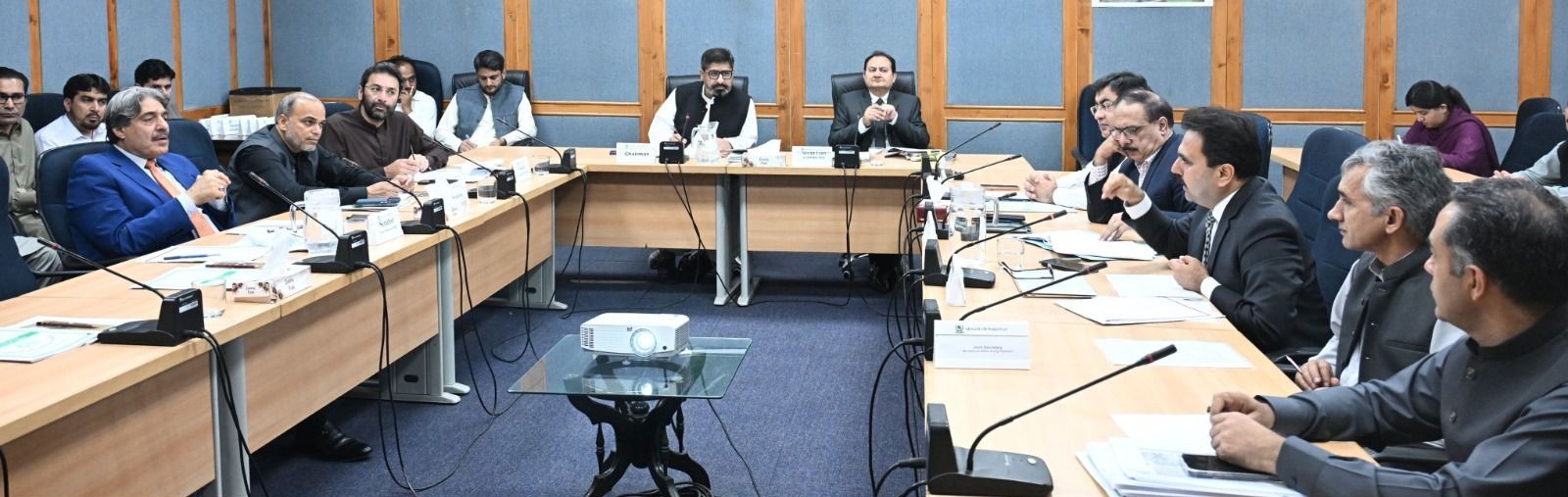
Press Release Title: Senator Asad Qasim, Chairman Senate Standing Committee on Kashmir Affairs and Gilgit-Baltistan presiding over a meeting of the committee at Parliament Lodges Islamabad.
Press Release Date: 16th June, 2026
Senate Committee Reviews Trophy Hunting Programme in Gilgit-Baltistan The Senate Standing Committee on Kashmir Affairs, Gilgit-Baltistan and States and Frontier Regions met at Old PIPS Hall, Parliament Lodges, Islamabad, under the chairmanship of Senator Asad Qasim. The meeting was attended by Senator Nadeem Ahmed Bhutto, Senator Faisal Saleem Rehman, and Mr. Nasir Mehmood, while Senator Agha Shahzaib Durrani participated as a special guest. Representatives from relevant government departments also attended the meeting. The Committee was informed that wildlife conservation in Gilgit-Baltistan is regulated under the GB Wildlife Preservation Act, 1975, which provides for controlled and regulated hunting under various schedules. Officials further apprised the Committee that the region’s first national park, Khunjerab National Park (KNP), was established in 1975. The concept of Participatory Natural Resource Management (NRM) gained prominence in the late 1980s, paving the way for greater community involvement in conservation efforts. The Committee was further briefed that the Trophy Hunting Programme was launched in 1998 with the support of the International Union for Conservation of Nature (IUCN). At present, trophy hunting is being carried out in 63 Community Controlled Hunting Areas (CCHAs) across Gilgit-Baltistan and is regulated under the GB Trophy Hunting Guidelines, 2019. Officials highlighted that the programme is widely regarded as a successful community-based conservation model, with 80 percent of revenue generated from trophy hunting allocated to local communities and 20 percent retained by the government. Moreover, Officials informed the Committee that three ungulate species are included in the programme, namely Astor Markhor, Blue Sheep, and Himalayan Ibex. They stated that four exportable permits have been allocated for Astor Markhor, while Blue Sheep has been allocated eight exportable and six non-exportable permits. Similarly, Himalayan Ibex has been allocated 50 exportable and 50 non-exportable permits. It was further informed that the CITES Management Authority under the Ministry of Climate Change is responsible for allocating trophy hunting quotas. CITES determines quotas for Appendix-I species, including Astor Markhor. During the last five years, a total permissible quota of 590 animals was allocated under the programme. Out of these, 181 permits were issued to foreign hunters and 138 to national and local hunters. A total of 319 hunts were successfully conducted, including 17 Astor Markhor, 39 Blue Sheep, and 263 Himalayan Ibex. Upon inquiry by the Chairmain Committee regarding population assessment methods, officials stated that local communities provide initial estimates, which are later verified through departmental field surveys. Minor variations of 15 to 20 animals may occur. However, figures are generally considered reliable. The Committee was informed that the Trophy Hunting Programme generated Rs. 1,008.72 million during the last five hunting seasons (2021–22 to 2025–26) Of this, 80 percent (Rs. 806.977 million) was distributed to local communities, while 20 percent (Rs. 201.741 million) was retained by the government. Officials noted that revenue during the 2025–26 season declined due to reduced participation by foreign hunters amid the Iran–US conflict, resulting in fewer successful hunts. Subsequently, Officials informed the Committee that foreign hunters are required to make advance payments against allocated permits, and refunds are issued for unutilized quotas. This refund mechanism, they added, has been well received by foreign hunters. During the discussion, Senator Agha Shahzaib Durrani sought details regarding the Astor Markhor population. Officials informed the Committee that the population stands at approximately 7,500 animals. The Senator observed that natural mortality and territorial conflicts among males may be significant and suggested reviewing the hunting quota to curb illegal hunting and enhance revenue generation for conservation and communities. After detailed deliberations, the Committee decided to constitute a sub-committee to examine the matter. The Chairman committee directed the sub-committee to visit Gilgit-Baltistan, consult all stakeholders, and submit a comprehensive report within 30 days. Officials also informed the Committee that forest cover in Gilgit-Baltistan stands at 4.82 percent, including social forestry. Under the Gilgit-Baltistan Forest Act, 2019, forests in Diamer District are classified as private forests (71 percent), while the remaining 29 percent are protected forests. Forest ownership derives from the Accession Deed of 1952 and the Forest Act, 2019, and management is carried out in accordance with applicable laws and approved working plans. The Committee expressed serious concern over illegal forest cutting and emphasized the need for effective enforcement mechanisms and a transparent permission system to ensure sustainable forest management. After a detailed briefing, Chairman committee constituted a sub-committee to examine the matter. The Committee was further briefed on maintenance allowances for beneficiaries of former princely states and their dependents under approved budgetary provisions. These include the Ameer of Bahawalpur, Mir of Khairpur, notables of Chitral, dependents of former Nawabs of Dir and Makran, dependents of the former Khan of Kalat, Nawab of Junagadh, Khan of Manavadar, and Sheikh Sahib of Mangrol. The total annual allocation for these beneficiaries amounts to Rs. 40.936 million, disbursed through the budgets of the Ministry of Kashmir Affairs, Gilgit-Baltistan & SAFRON and the Ministry of Finance in accordance with approved rules. Following a detailed briefing on the affairs and privileges of former and acceding states, the Committee deferred the matter for further consideration in its next meeting. The Committee directed the Officials to provide comprehensive details, including the number of vehicles in use, their utilization status, budgetary allocations, the legal and administrative framework governing such allocations, and the competent authority responsible for decisions regarding budget distribution.